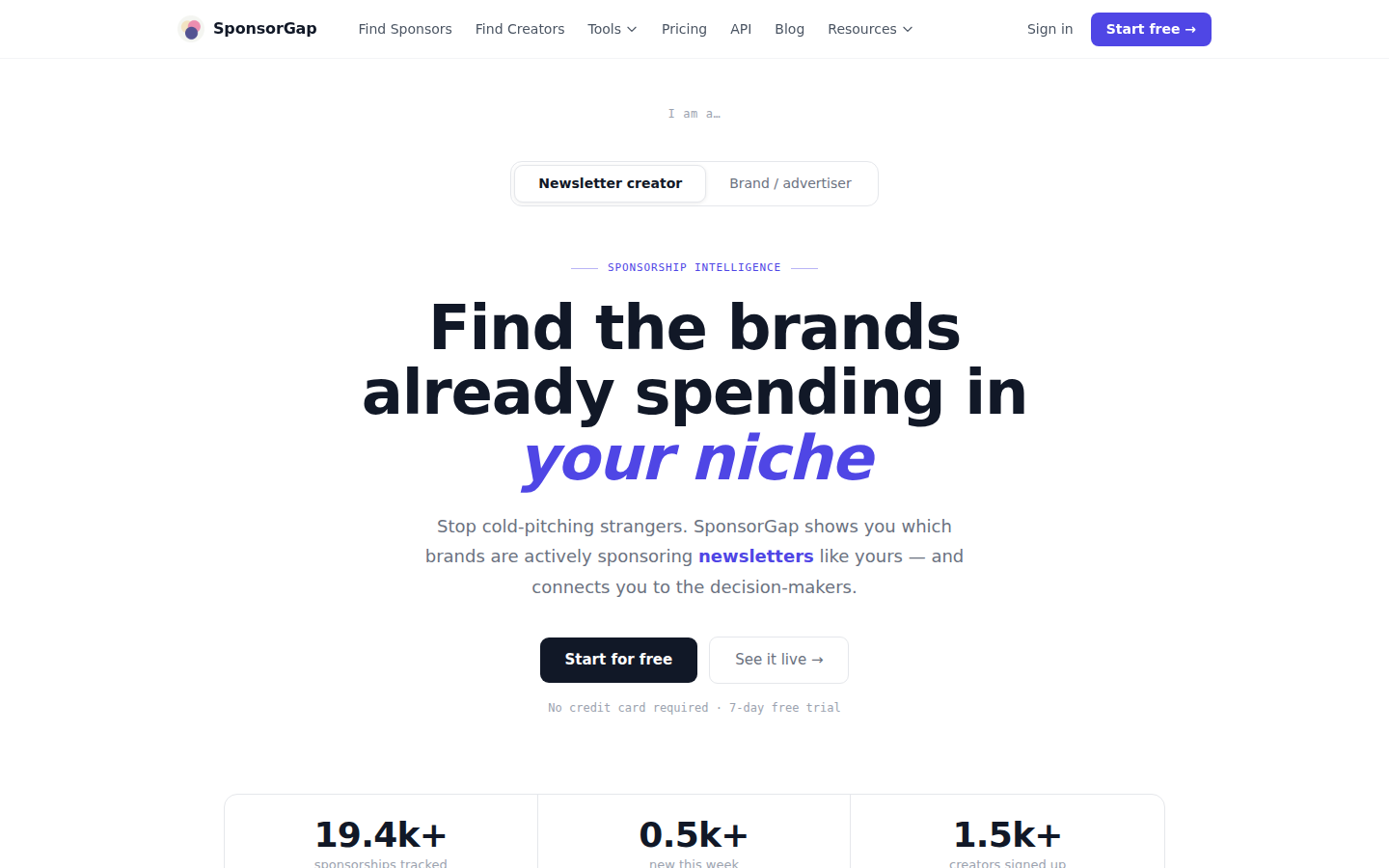
SponsorGap tackles one of the slowest parts of newsletter monetization: finding brands that have already shown they buy newsletter ads. Instead of building a prospect list from random companies, a creator can research recent sponsor activity, check niche fit, look for the right contact and prepare a smaller set of relevant pitches.
That can save research time, but it does not turn sponsorship sales into passive income. On its self-service plans, SponsorGap supplies data and a lightweight pipeline; the creator still writes the pitch, sends it, proves audience value, negotiates the placement and delivers the campaign. The useful question is not whether the database looks large. It is whether it helps you find better-fit buyers than the free research you could do yourself.
| At a glance | Practical meaning |
|---|---|
| Best fit | A newsletter with a defined niche, consistent publishing, a credible media kit and time for personalized outreach. |
| Main job | Find brands already appearing in newsletters, inspect activity and contact signals, then build a qualified outreach list. |
| Revenue path | Sell direct newsletter placements, research sponsors for a client, or use the data to support a sponsorship sales service. |
| Main risk | A database can shorten research without making the audience attractive or the pitch persuasive. |
| Bad fit | A new newsletter with no clear audience, no publishing consistency and no plan to contact or close sponsors. |
What SponsorGap is actually selling
SponsorGap describes itself as sponsorship intelligence for newsletter creators and brands. Its public pages combine sponsor discovery, activity history, industry filters, contact details, competitor monitoring, exports, a basic outreach pipeline, an ad-slot marketplace and higher-tier API access. The central promise is simple: start with companies that have evidence of newsletter ad spend instead of treating every brand as equally likely to buy.
The public help center makes an important boundary clear. The self-service product does not send emails on a creator's behalf. You export or inspect the contacts, write from your own email account and track the stages yourself. Managed outreach appears on separate, much more expensive plans.
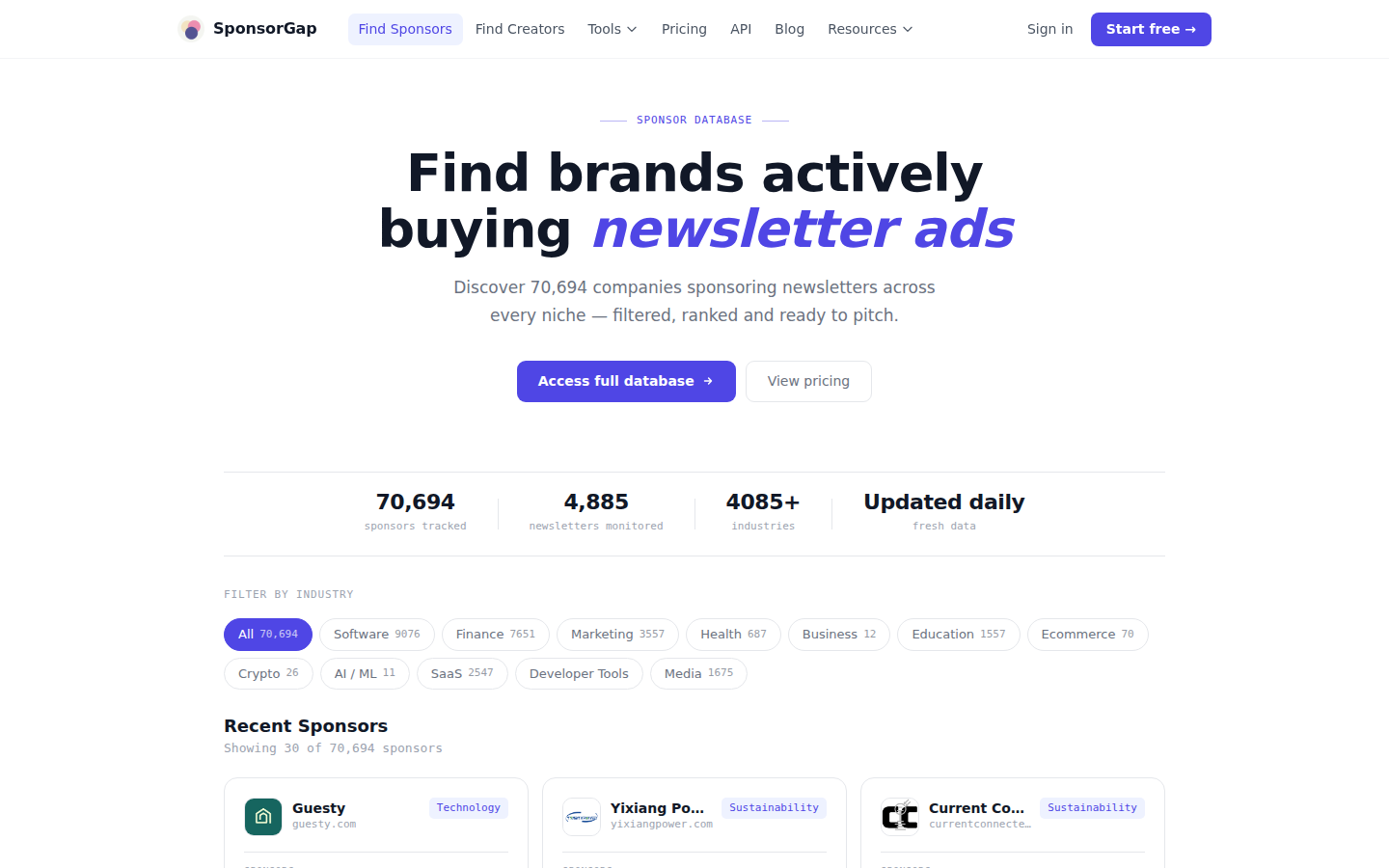
The public pages currently show inconsistent database totals. Different screens refer to 25,000-plus records, 70,000-plus sponsors or brands, and other live counters. Those may reflect different definitions or update paths, but a buyer should not use the biggest headline as proof of useful coverage. Search your exact niche during the trial and count relevant, recent, contactable prospects.
The useful workflow: research before outreach
- Define the sponsor profile before opening the database. Write down the newsletter niche, audience location, job or interest, subscriber range, engagement evidence, ad format and realistic price.
- Search for brands already appearing in adjacent newsletters. Recent placements are a stronger starting signal than a generic list of companies in the same industry.
- Inspect fit, not just activity. A frequent sponsor may target a different country, audience size, buying stage or price range. Record why the brand should care about your readers.
- Build a short list. Twenty researched prospects with a relevant reason to contact them are more useful than a 5,000-row export that becomes another cold-email blast.
- Verify the decision-maker and contact route. Roles change, inboxes decay and vendor contact data can be wrong. Check the company site and current role before sending.
- Write a pitch around the brand's likely goal and your audience evidence. Mention one relevant placement or campaign pattern, but do not pretend to know its budget.
- Track replies, objections and outcomes. After a fixed batch, compare positive replies, booked calls or paid placements with the time and subscription cost.
If the research later feeds a larger automation workflow, tools such as n8n lead-generation agents or Gumloop workflows can help with enrichment and routing. Keep human review before any email. Sponsor evidence is permission to investigate, not permission to spam.
Pricing and the break-even question
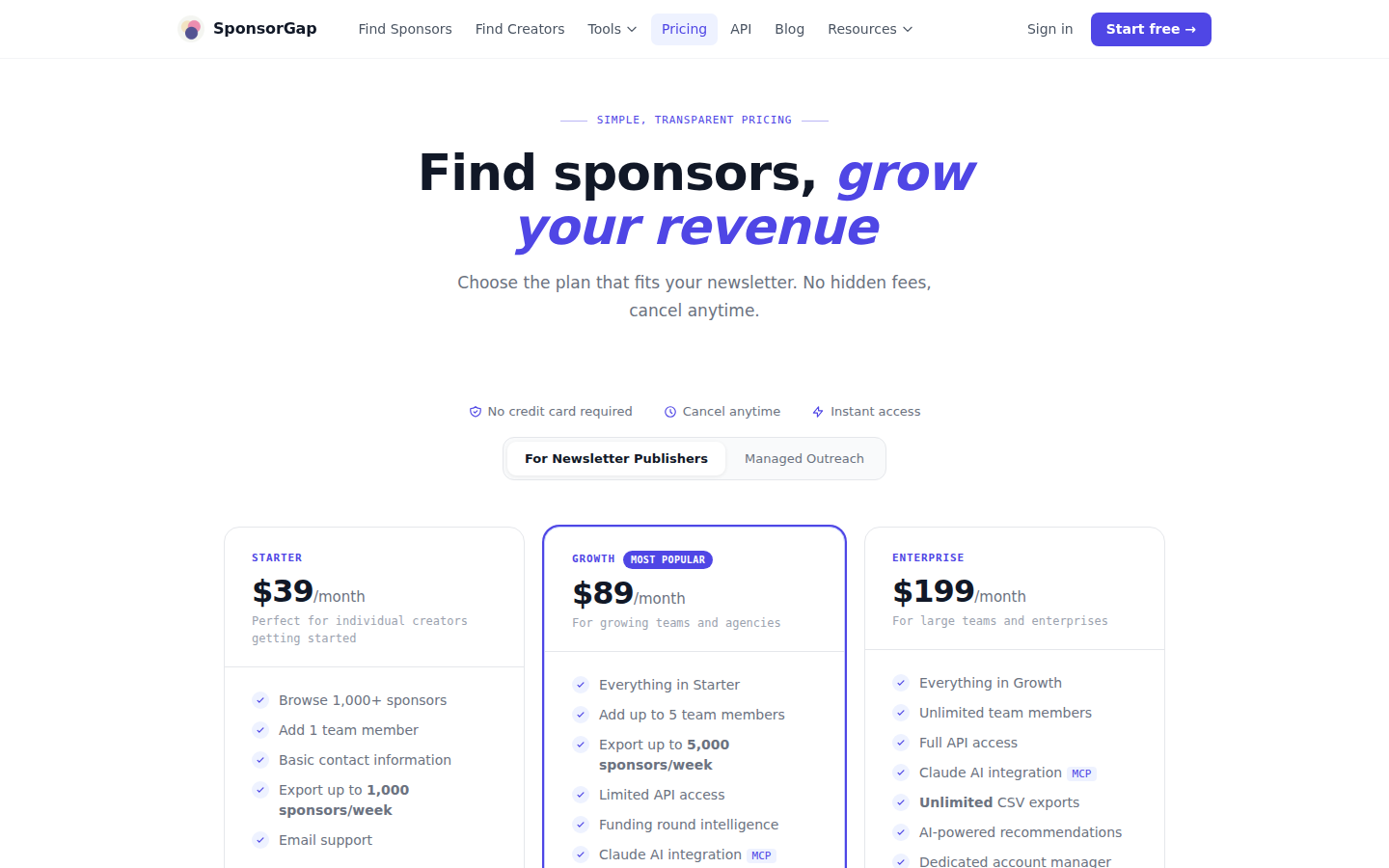
SponsorGap's public pricing page currently lists self-service plans at $39, $89 and $199 per month. The tiers add exports, team access, contact or monitoring features and API capacity. The same site uses different plan names and some different feature wording between its pricing and help pages, so verify the exact entitlement inside the trial before choosing a tier.
| Cost question | How to evaluate it |
|---|---|
| Can the niche search return enough recent buyers? | Run the free search or trial using your real category, adjacent newsletters and target geography. |
| Are contacts usable? | Manually verify a sample of roles, domains and recency before exporting a large list. |
| Will you actually send personalized pitches? | A paid database has no return if it becomes a saved list that nobody works. |
| What is one placement worth after delivery cost? | Use the net contribution after writing, design, tracking, revisions and any sales help, not the invoice total. |
| Can free research find the same brands? | Compare SponsorGap with reading competitor newsletters, public sponsor lists and direct brand research for one week. |
A simple break-even model is more useful than a revenue promise. If a newsletter can genuinely net $150 from one placement, the $39 plan equals 26% of that amount and one such booking would cover about 3.85 months of subscription cost. The $89 plan would be covered for about 1.69 months. That does not mean the tool caused the deal, and it does not include outreach time.
A competitor-authored analysis from Book a Sponsor reaches a similar practical conclusion: a sponsor database is useful only if the creator will do the sending and follow-up. Its benchmarks come from its own competing outreach service, so treat them as a comparison point rather than neutral proof of SponsorGap performance.
What the research can and cannot prove
| Signal | What it can suggest | What it cannot prove |
|---|---|---|
| A recent newsletter placement | The brand has used newsletter advertising recently. | That it still has budget, accepts cold pitches or will buy your audience. |
| Repeated sponsorships | The channel may be part of an ongoing acquisition mix. | That every newsletter, niche or rate is profitable for the brand. |
| A named contact | There may be a more relevant route than a generic support inbox. | That the person still owns the budget or wants unsolicited outreach. |
| A competitor placement | Your audience may overlap with a known buying pattern. | That your positioning, engagement and creative are equivalent. |
| A marketplace listing | A brand or creator is open to discovery inside the platform. | That a deal will close without sales work, proof and negotiation. |
Product Hunt and InboxReads confirm that SponsorGap has existed as a newsletter sponsorship product since its 2021 launch. That is useful maturity context, but current independent hands-on review depth is still thin. The most detailed recent public analysis I found is competitor-authored and explicitly says it did not test the private contact data. Use the trial to validate your own niche rather than borrowing someone else's confidence.
A low-risk seven-day trial plan
| Day | Test | Pass condition |
|---|---|---|
| 1 | Search your niche, two adjacent niches and five competitor newsletters. | You find a usable pool of recent sponsor activity rather than mostly irrelevant brands. |
| 2 | Review 25 prospects and record fit, recency, audience clues and contact quality. | At least half survive manual qualification. |
| 3-4 | Write and send a small personalized batch using your normal email process. | The workflow is manageable and messages remain genuinely tailored. |
| 5 | Compare with an hour of free manual research. | The tool saves enough time or reveals enough unique prospects to matter. |
| 6 | Review replies, bounces and wrong-contact signals. | Data quality is acceptable for your niche; no single result proves sales performance. |
| 7 | Choose cancel, continue or test a higher tier. | The next month's research and outreach plan is specific enough to use the subscription. |
Do not measure the trial by the number of rows exported. Measure qualified prospects per hour, verified contacts, personalized pitches completed and eventual positive replies. A small newsletter may need more than seven days to close a placement, but it can still determine whether the research process is materially better.
Could SponsorGap support a client service?
The data can also support a contained research service for newsletter operators, agencies or creator managers. The sellable result is not access to the database. It is a reviewed sponsor shortlist with fit notes, recent evidence, current contacts and suggested pitch angles. That service still needs careful data handling and clear boundaries.
| Service component | Useful deliverable | Boundary |
|---|---|---|
| Sponsor research | A short list ranked by recent activity and audience fit. | Do not resell raw vendor data if the product terms do not allow it. |
| Contact verification | Current role, public company route and verification date. | Do not guarantee delivery or a reply. |
| Pitch preparation | A relevant opening, proof points and one clear offer. | Keep claims true and avoid fake familiarity. |
| Pipeline setup | Contacted, follow-up, replied, negotiating and closed stages. | One polite follow-up is enough; do not build a harassment machine. |
| Monthly review | Qualified prospects, replies, objections and booked revenue. | Separate tool-assisted discovery from deals that came through other channels. |
This model is closer to a research-and-sales service than the passive publisher monetization discussed in TinyAdz for small blogs. It also differs from the marketplace-first angle in Sponsorships.ai for creators. SponsorGap's strongest role is upstream: deciding which brands deserve a thoughtful pitch.
Risks to manage
- Data freshness: sponsor activity and contact roles change. Verify important records before outreach.
- Definition drift: public totals and plan descriptions are not fully consistent across the product's pages. Test the fields you actually need.
- Selection bias: brands visible in large newsletters may not buy small or specialized audiences at the same rates.
- Outreach quality: bulk exports make it easy to send low-context email that damages sender reputation and brand trust.
- Privacy and compliance: use business contact data responsibly, provide a clear reason for contact and respect opt-outs and applicable rules.
- Attribution: a deal may result from an existing relationship, marketplace discovery or timing rather than the database alone.
- Tool dependency: preserve your own notes, outcomes and relationship history so the sales process is not trapped in one platform.
When SponsorGap is worth testing
- You publish consistently for a clear audience and already have a credible sponsorship offer.
- You can name competing or adjacent newsletters whose sponsors are relevant to your readers.
- Manual sponsor research takes significant time and you will use the saved time for personalized outreach.
- You are willing to verify contacts, track outcomes and cancel if the niche coverage is weak.
- One realistic placement can cover several months of software cost after delivery expenses.
When to avoid it
- The newsletter has no stable niche, publishing cadence or audience evidence yet.
- You want software to close deals without writing, follow-up, negotiation or campaign delivery.
- You plan to export thousands of contacts and send generic pitches.
- Free research already gives you enough qualified brands for the outreach capacity you have.
- Your sponsorship price or close rate cannot support another monthly tool after time and delivery costs.
Frequently asked questions
Does SponsorGap send sponsor pitches?
Not on the self-service plans described in its help center. The creator sends from a normal email client or connects other outreach tools. Separate managed plans advertise outbound execution at a much higher monthly price.
Does the marketplace guarantee inbound deals?
No. Listing open ad slots can create another discovery path, and the public help page says self-service marketplace deals have no platform commission. A listing still needs a credible audience, clear inventory, suitable pricing and a brand willing to buy.
Is SponsorGap useful for a small newsletter?
Potentially, if the audience is specific enough for brands to value and the creator will do disciplined outreach. Test niche coverage and contact quality first. Subscriber count alone does not determine sponsor fit, but a tiny or inactive audience gives a brand little reason to pay.
Should you automate the outreach?
Automate list hygiene, reminders and pipeline updates before automating message volume. Keep prospect selection and the final pitch under human review. A personalized email to a qualified buyer is more defensible than a large sequence built from a database export.
What is the first success metric?
Start with qualified prospects per research hour and positive reply rate from a small batch. Paid placements take longer and are the real business outcome, but those early metrics reveal whether the workflow is improving before you scale it.
Bottom line
SponsorGap offers a sensible shortcut: research brands with evidence of newsletter ad spend before deciding whom to pitch. Its activity history, filters, contacts, monitoring and pipeline can reduce prospecting friction for a creator who already has a clear audience and sales process.
The product is not the business. The business is matching a useful audience with a relevant advertiser, making a credible offer and delivering a campaign worth repeating. Validate one niche during the trial, work a short list, measure outcomes and keep only the tier that earns its place. If sponsorship outreach is not a fit, compare it with the wider email-marketing tool stack and online-business models covered on BuildForIncome.