Scrunch AI is interesting because AI search visibility has become a practical business question, not only an SEO buzzword. If buyers ask ChatGPT, Gemini, Perplexity or Google AI answers about a category, a brand wants to know whether it appears, how it is described and which competitors get mentioned instead.
This is not a hands-on Scrunch case study, and it is not a promise that any AI visibility platform can force an answer engine to recommend a brand. The useful BuildForIncome angle is narrower: can a solo operator, consultant or small agency turn AI visibility checks into a paid client audit and refresh workflow?
| Quick verdict | What to know |
|---|---|
| Best fit | Brands, consultants and agencies that already have content assets and need to understand how AI answers describe them. |
| Money-making path | Package AI visibility checks into audits, content refresh queues, competitor reviews and monthly reporting. |
| Main risk | Visibility dashboards can create anxiety without action unless every finding maps to a page, proof asset or positioning fix. |
| Worth testing when | You can sell a scoped audit or use it to improve an existing site with real buyer-intent pages. |
| Avoid when | The site has no clear niche, no service offer, or too little content to measure meaningfully. |
What Scrunch AI appears to do
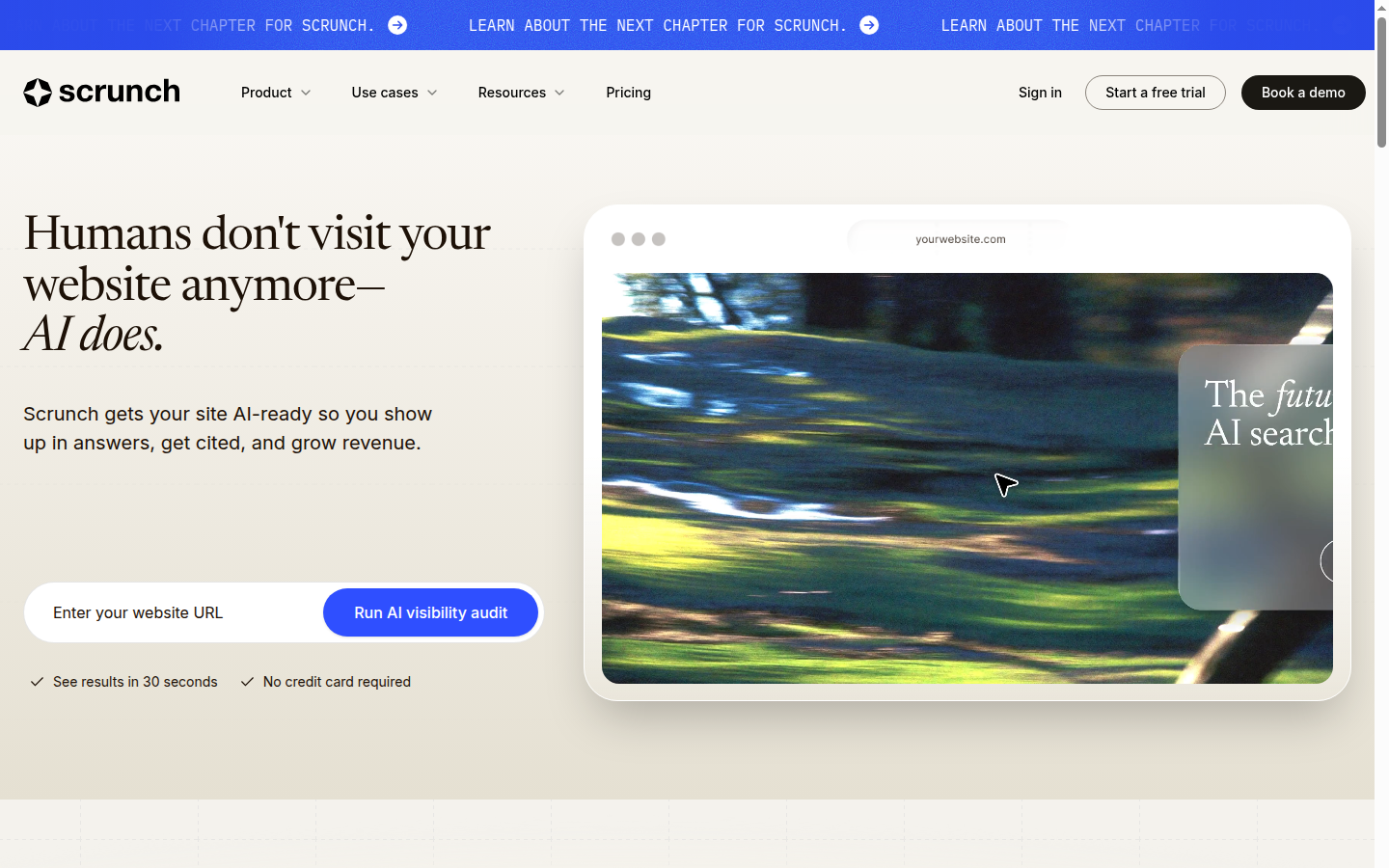
Scrunch publicly describes itself as an AI customer experience platform for AI search visibility and optimization. Its homepage talks about monitoring brand presence in AI search, analyzing and optimizing a website, and making content easier for AI agents to understand.
That makes the tool closer to an AI-search visibility and audit platform than a normal keyword tracker. The practical promise is not simply writing more articles. It is seeing how a brand shows up in answer engines, identifying content gaps and turning that into an action queue.
Why this can become a client audit
Most small businesses will not pay for a vague ‘AI search strategy'. They might pay for a concrete audit if it answers simple questions: are we mentioned, are competitors mentioned more often, are our services easy to understand, and what should we fix first?
| Audit component | What you check | Useful output |
|---|---|---|
| Brand visibility | How the brand appears across buyer-style prompts and answer engines. | A short list of missing, weak or incorrect mentions. |
| Competitor comparison | Which competitors are easier for AI systems to summarize and recommend. | Specific positioning and proof gaps. |
| Website readiness | Whether service pages, product pages, FAQs and About content explain the business clearly. | A page refresh queue rather than a vague strategy doc. |
| Monthly tracking | Whether updates change the way the brand is surfaced over time. | A reason to sell a small recurring reporting package. |
A practical service package
A sensible first offer would be a controlled audit, not a huge retainer. The goal is to prove that AI visibility work creates useful decisions before asking a client to pay for heavier software, content production or monthly reporting.
| Step | What to deliver | Keep it safe by |
|---|---|---|
| 1 | Pick one brand, one service category and a small set of buyer prompts. | Avoid random vanity prompts that no customer would ask. |
| 2 | Record how the brand and competitors are described across AI answers and search results. | Frame results as observations, not guaranteed ranking data. |
| 3 | Map every issue to a page, FAQ, comparison section, case study or external profile. | No recommendation should float without an action. |
| 4 | Create a 30-day refresh queue. | Prioritize existing pages before creating new content. |
| 5 | Recheck after changes and decide if monthly reporting is worth it. | If nothing changed or no decisions improved, stay lighter. |
Pricing and margin checks
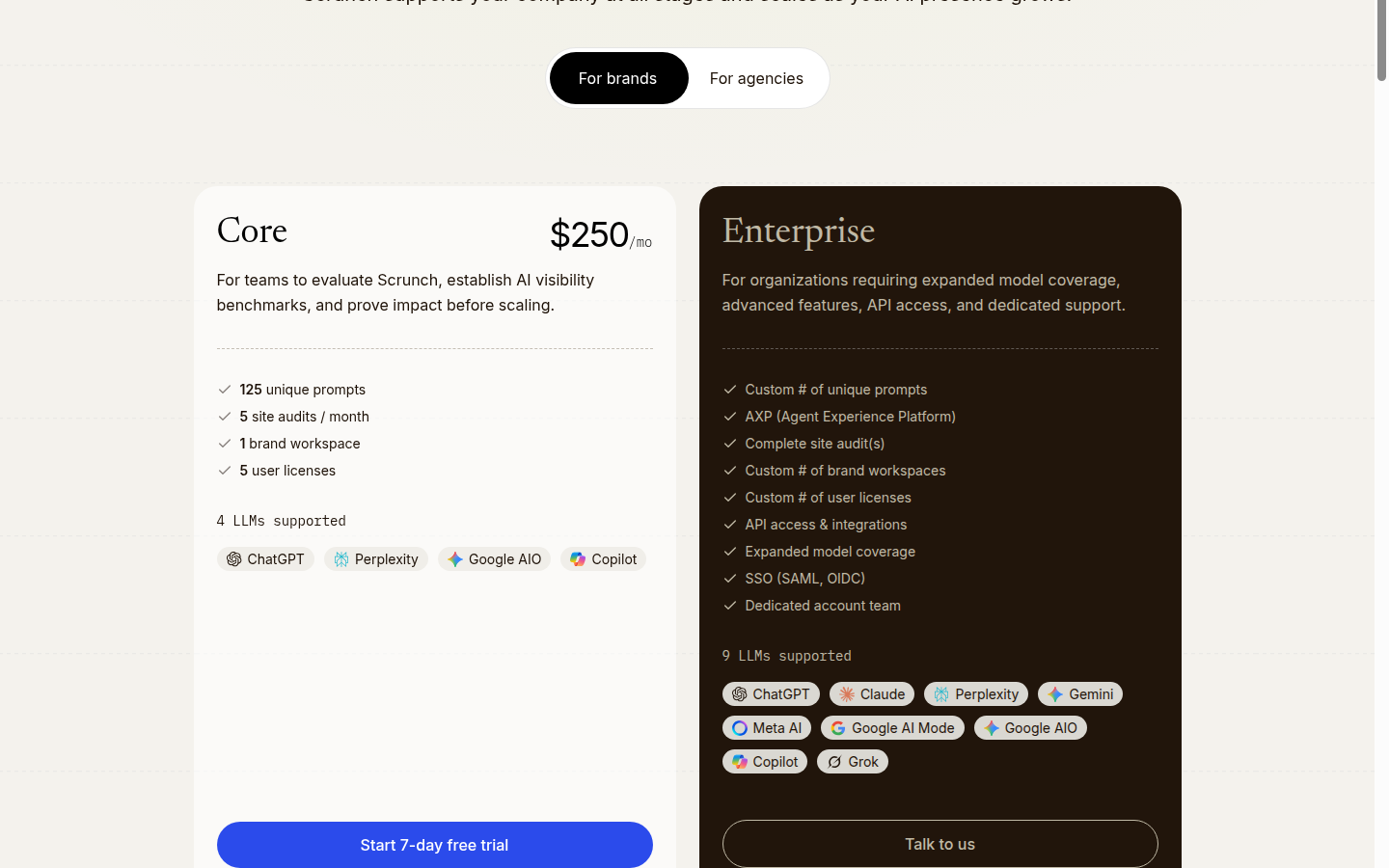
Scrunch's public pricing page currently shows a Core plan at $250/mo and an Enterprise option, with visible limits around unique prompts, site audits, brand workspaces, user licences and supported AI systems. Pricing and plan limits can change, so check the live pricing page before quoting a client package.
| Cost factor | Why it matters | Margin protection |
|---|---|---|
| Prompt volume | More prompts can mean better coverage, but also more noise and review time. | Start with a tight buyer-intent prompt set. |
| Site audits | If the plan limits audits, a multi-client service can run out quickly. | Sell one scoped audit first before offering retainers. |
| Supported systems | Different clients may care about ChatGPT, Perplexity, Google AI answers or other surfaces. | Report only on answer engines that match the buyer journey. |
| Human review | The expensive part may be interpreting findings and turning them into useful content changes. | Charge for analysis and implementation, not only the software screenshot. |
Where Scrunch looks useful
- Brands with enough existing pages, products or services to make AI visibility measurement meaningful.
- Agencies that want a repeatable way to explain answer-engine visibility to clients.
- Consultants who can turn visibility gaps into page updates, proof assets, FAQs and comparison content.
- Operators building a wider AI SEO workflow where measurement, content refreshes and reporting all matter.
Where to be skeptical
- AI search results shift quickly, so one snapshot should not be sold as permanent truth.
- A dashboard does not create authority, trust, links, case studies or better page content by itself.
- Small sites with thin content may need basic positioning and useful pages before paid visibility tooling.
- Clients may hear ‘AI visibility' and expect guaranteed mentions unless the scope is explained carefully.
- Any income path depends on selling useful audits or implementation work, not on the tool magically creating leads.
Scrunch vs lighter AI SEO tools
| Option | Better for | Main caution |
|---|---|---|
| Scrunch | AI search visibility audits, brand monitoring, answer-engine readiness and client reporting. | Can be too heavy if the site does not yet have enough useful content or a clear service offer. |
| LLaMaRush | Founder-style AI SEO workflows and search monitoring. | Still needs human quality checks and original examples. |
| SEObotAI | Autonomous SEO-style content production and internal linking. | Automation can create weak content if strategy and review are thin. |
| SEOmatic | Programmatic SEO pages and scalable content templates. | Bad data and repeated templates can create thin pages quickly. |
| Manual audit | Early-stage sites and tiny budgets. | Slower, but often safer until the opportunity is proven. |
For adjacent BuildForIncome coverage, compare this with LLaMaRush, SEObotAI, SEOmatic, Gumloop workflows and n8n lead-generation agents. Scrunch fits the measurement and audit side of the cluster more than the generic content-generator side.
When it is worth testing
- You already have a client or owned site with real pages to audit.
- You can define buyer prompts before opening the tool.
- You can translate findings into refreshes, FAQs, comparison pages, case studies or entity cleanup work.
- You want to test a small AI visibility audit offer before promising ongoing AEO management.
- You are building a broader system around AI tools for online income and practical online business workflows.
When to avoid it
- Avoid it if you have no clear niche, no customer journey and no meaningful website assets to inspect.
- Avoid it if you plan to sell screenshots without implementation work.
- Avoid it if the client expects guaranteed ChatGPT or Gemini recommendations by a fixed date.
- Avoid it if a basic Search Console review, manual competitor analysis and a content refresh brief would answer the same question more cheaply.
Bottom line
Scrunch AI is a good BuildForIncome topic because it connects AI search visibility with a real service idea: audit how answer engines understand a brand, then turn the findings into content and positioning work.
The safest way to test the opportunity is small and specific: one brand, one topic cluster, one prompt set, one competitor set and one 30-day refresh queue. If that creates decisions a client would not have made otherwise, the service has potential. If it only creates another dashboard, stay lighter and focus on better pages first.