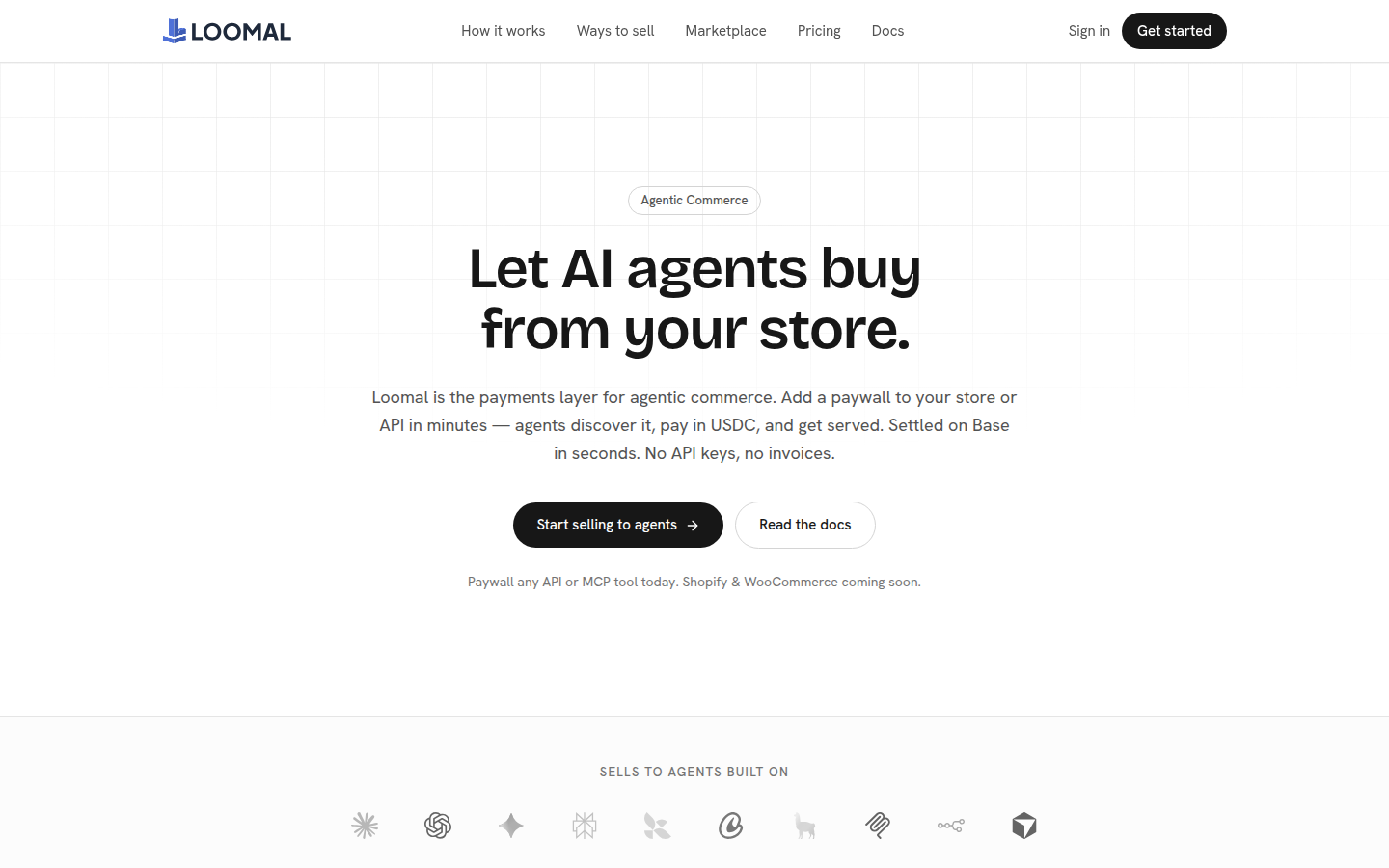
Loomal is built around a new kind of checkout: an AI agent discovers an API or Model Context Protocol tool, receives a price, pays in USDC over the x402 protocol, and gets the result without a human creating an account or buying a credit pack. For a small developer, that raises an interesting question. Can one useful endpoint become a tiny paid product instead of another free demo?
The answer is potentially yes, but only for a narrow job with real demand. Loomal can simplify payment and discovery. It cannot prove that agents want the endpoint, keep the service reliable, absorb support work, or decide whether crypto settlement fits the seller's accounting and customers.
| At a glance | Practical meaning |
|---|---|
| Best fit | A reliable API or MCP tool that performs one valuable, repeatable job and can be priced per call. |
| Revenue model | The seller sets a per-call USDC price while Loomal handles the x402 payment challenge and settlement flow. |
| Good first test | One remote endpoint, one buyer profile, a small free quota and a short demand-validation window. |
| Main risk | The market for autonomous agent purchases is early, so technical integration can work before customer demand exists. |
| Bad fit | Work that requires a human contract, sensitive identity checks, complex refunds, or unpredictable manual effort on every request. |
What Loomal does
Loomal describes itself as a payment layer for agentic commerce. A developer can wrap an HTTP endpoint or MCP tool with payment middleware, publish a price, and receive payment before the protected handler runs. Its public documentation says the flow returns HTTP 402 Payment Required, verifies the agent's signed authorization, settles USDC on Base, and returns a signed receipt.
The practical value is not a magical new business model. It is the removal of several small but expensive pieces: account creation, API-key issuance, prepaid credits, metering and a conventional card checkout for tiny transactions. That can be useful when the buyer is software and the product is one machine-readable result.
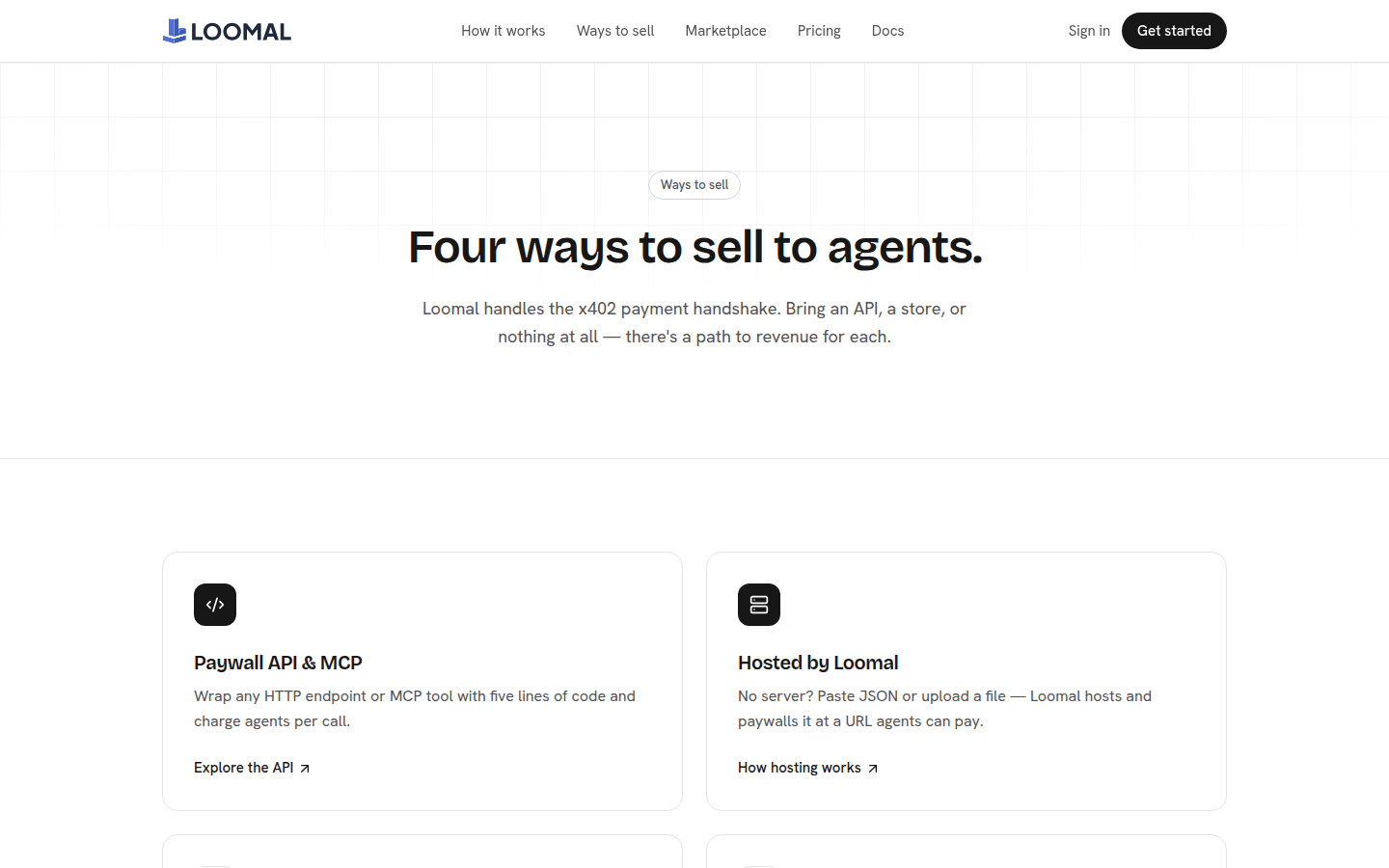
The currently useful paths are API and MCP paywalls plus hosted files or JSON. Loomal's public pages label Shopify and WooCommerce support as coming soon, so a seller should not design a store workflow around those integrations until the live product pages say they are available.
What makes a paid MCP tool worth calling?
A paid tool needs to produce value that is easier to buy than to recreate. Generic wrappers around a public endpoint are weak products because an agent builder can often call the original source directly. A stronger tool combines data, compute, reliability or a difficult workflow into an output that saves more than its price.
| Possible tool | Sellable unit | What the seller must prove |
|---|---|---|
| Document extraction | One page, file or structured document result. | Accuracy on messy inputs, predictable latency and safe file handling. |
| Fresh web research | One query or one source-backed brief. | Freshness, citations, coverage and a cost below the value of doing the research manually. |
| Specialist calculation | One validated calculation or transformed dataset. | Correct formulas, clear limits and enough audit detail for the caller to trust the result. |
| Enrichment | One company, domain or record returned in a defined schema. | Data rights, match quality, recency and a policy for missing results. |
| Compute-heavy AI task | One transcription, OCR, classification or inference job. | A price that covers model and infrastructure cost at realistic input sizes. |
This is adjacent to packaging expertise with Kopai paid agents, but the product boundary is different. Kopai focuses on paid conversations with a domain agent. Loomal is more natural when the thing being sold is a deterministic tool call, API response or hosted digital result.
A small developer should validate the job before the payment rail
- Choose a request that a real agent workflow already makes. Start from logs, support questions, developer requests or a task you repeatedly automate, not from the existence of a new payment protocol.
- Define one billable unit. Good units include a page processed, a record enriched, a query answered or a file transformed. Avoid a vague ‘AI task' whose cost and output can change wildly.
- Measure the full variable cost. Include upstream APIs, model tokens, browser or compute time, storage, retries, failed calls and support. A price above raw compute can still lose money if exception handling is manual.
- Expose a safe sample. Let buyers inspect a schema, example response, tool description and limitations before payment. A machine buyer still needs enough metadata to select the tool correctly.
- Test a free or tightly capped path with a few target users. Confirm that the result enters a real workflow and is worth paying for before polishing a large catalogue.
- Add a stop condition. If discovery produces no qualified calls, if repeat use stays at zero, or if failures require frequent rescue, fix the job before adding more endpoints.
A structured intake layer such as FormHug for agent-ready lead capture can help when humans provide the initial requirements. Workflow platforms such as Gumloop and n8n lead-generation agents can orchestrate several systems. Loomal belongs at the point where one callable service is valuable enough to meter and sell.
Pricing: model contribution margin per successful call
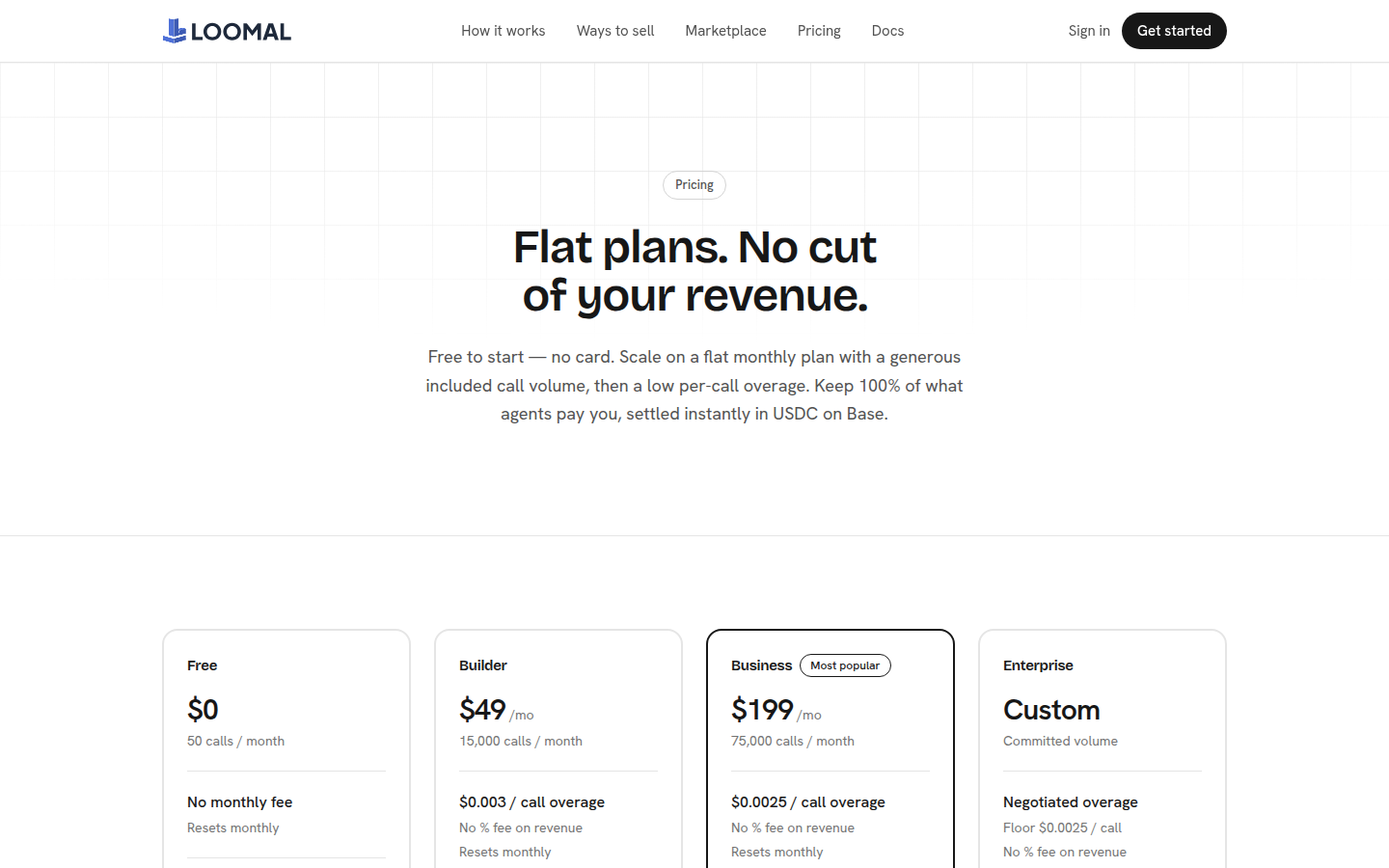
Loomal's current public pricing page shows a free tier with 50 calls per month, a Builder plan at $49 per month with 15,000 included calls, and a Business plan at $199 per month with 75,000 included calls. Paid plans list per-call overage and no percentage fee on seller revenue. These are live product terms, not permanent constants, so recheck the pricing page before building a forecast.
| Cost layer | Question to answer |
|---|---|
| Loomal plan | How many successful and failed paywalled calls count toward the included volume and overage? |
| Upstream compute | What is the worst realistic model, API, browser or storage cost for one accepted request? |
| Payment and wallet operations | What operational, conversion, withdrawal or accounting work applies to USDC on Base in your jurisdiction? |
| Support and refunds | How will you handle a paid result that times out, duplicates, arrives incomplete or disappoints the buyer? |
| Maintenance | How many monthly hours are needed for monitoring, schema changes, security patches and source updates? |
The useful metric is contribution margin per successful call, not revenue per call. If a tool sells for $0.03 but occasionally triggers a costly retry or ten minutes of support, the attractive micropayment becomes a bad product. A higher-value endpoint with fewer calls may be healthier than a large volume of near-free traffic.
Discovery is helpful, but it is not demand
Loomal also operates a marketplace or index where agents can discover listings. That can reduce distribution friction, especially when a listing exposes a clear schema and price. It should not be treated as a guaranteed source of customers. A large directory can contain many unclaimed, free or lightly used tools, and listing count is not the same as buyer activity.
A small seller should bring an initial distribution path: documentation users, an open-source project, a developer community, an existing API audience, a newsletter, direct outreach or a tool embedded in a broader service. Marketplace discovery is then an additional channel rather than the entire go-to-market plan.
| Distribution path | Strength | Trade-off |
|---|---|---|
| Loomal marketplace | Machine-readable discovery and a visible price close to the transaction. | Early-market liquidity and ranking are outside the seller's control. |
| Own documentation | Reaches developers who already understand the problem and can inspect examples. | You must earn search traffic, trust or community attention. |
| Open-source project | A free local version can prove usefulness and create a natural path to paid hosted capacity. | Support expectations can grow before revenue does. |
| Client service | A paid endpoint can make delivery repeatable inside a higher-value service. | The business is less passive and still depends on sales and account management. |
Operational risks that a five-line integration does not remove
- Authentication and authorization: payment proves that a call was paid for, not that the caller may access a particular user's private data.
- Abuse and input safety: a paid request can still contain malicious files, prompt injection, oversized payloads or attempts to reach internal systems.
- Reliability: buyers need timeouts, idempotency, rate limits, retry rules and clear behavior when settlement succeeds but the job fails.
- Data rights: selling transformed data does not automatically give permission to collect, redistribute or retain the source material.
- Wallet and accounting: USDC settlement may create recordkeeping, conversion, tax or compliance work that depends on the seller's location and business structure.
- Buyer fit: many current customers still prefer cards, invoices or ordinary API subscriptions. x402 should match the buyer rather than replace familiar billing by ideology.
- Vendor dependency: keep the core endpoint, price logic and usage records portable enough to change payment or discovery providers later.
For private user data, payment and identity may need to be separate layers. A calendar or CRM tool can require user authorization even if a public enrichment endpoint only needs payment. Treat access control as a product requirement, not an optional detail added after launch.
When Loomal is worth testing
- You already operate a remote API or MCP tool with a clear, measurable output.
- The result saves an agent more money or time than the per-call price and is difficult to reproduce reliably for free.
- Your marginal cost is known, bounded and covered by the planned price.
- The intended buyers can use x402 and USDC on Base without creating more friction than a normal API account.
- You can monitor failures, support buyers and keep the endpoint secure without turning each call into manual work.
When to avoid it
- The idea begins with ‘agents will buy this' but there is no evidence that any workflow needs the output.
- Every request needs judgement, negotiation, custom scoping or a human review that is not reflected in the price.
- The service handles high-stakes personal, financial, legal or health decisions without qualified oversight.
- Your customers need invoices, card refunds, purchase orders or conventional subscriptions and do not use agent wallets.
- You are waiting for Shopify or WooCommerce support that the current public pages still mark as coming soon.
Frequently asked questions
Does Loomal build the MCP server for you?
Not by default. The core offer is a payment and discovery layer around an endpoint or MCP tool you operate. Loomal also advertises hosted files or JSON for simpler products, but the seller remains responsible for the usefulness, rights and accuracy of what is sold.
Can a paid MCP tool become passive income?
It can automate delivery, but it is not automatically passive. Infrastructure, security, source freshness, failed calls, support, pricing and distribution still need attention. Treat the first endpoint as a product experiment with operating costs.
Do agents need USDC?
Loomal's public flow is based on x402 payments settled in USDC on Base. The buyer's software therefore needs compatible payment capability. If the intended customers do not have that capability, ordinary API keys with card or invoice billing may be easier.
What should the first success metric be?
Track repeat paid use from a small number of real workflows. Listing views or free calls can show interest, but repeat use after a successful result is stronger evidence that the endpoint solves a valuable job.
Bottom line
Loomal is an interesting infrastructure bet on software becoming a direct buyer. It can make a tiny API or MCP transaction easier by combining a price, payment challenge, settlement and discovery. That is useful plumbing, especially for outputs that are naturally sold per record, file, query or compute job.
The practical opportunity is narrower than the agentic-commerce label. Build one paid endpoint around a proven job, verify the cost of every successful and failed call, test whether compatible buyers return, and keep a conventional alternative available. If the experiment works, expand carefully. If it does not, the same capability may fit a client service, fixed digital product or one of the broader AI income tool models and online-business ideas covered on BuildForIncome.