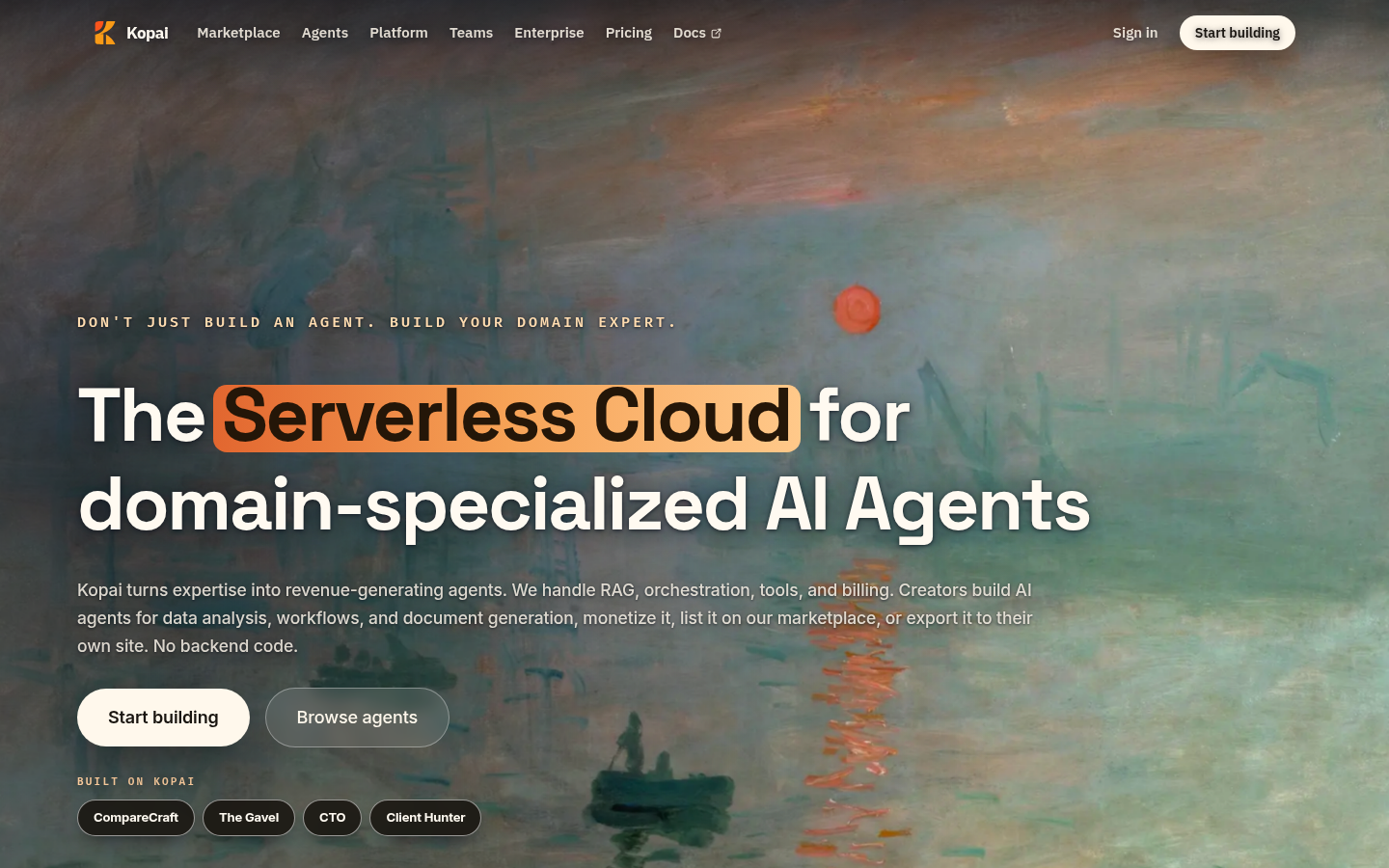
Kopai has a more specific business pitch than a generic AI-agent builder: package useful expertise into a domain-focused agent, list it in a marketplace, and charge users per message. That sounds attractive to consultants, operators and educators who have repeatable knowledge but do not want to build billing, retrieval and agent infrastructure from scratch.
The opportunity is real enough to test, but the product does not remove the hard parts of a knowledge business. You still need a narrow problem, trustworthy material, useful evaluation cases, a sensible price and a way to reach buyers. A technically capable agent with no demand is still an empty shop.
| At a glance | Practical meaning |
|---|---|
| Best fit | A specialist with documented, repeatable knowledge that solves one recurring and reasonably bounded problem. |
| Revenue model | Users spend credits per message. A publisher adds a charge on top of runtime cost and receives a share of that add-on. |
| Good first test | One narrow agent, one target audience, a small evaluation set and a short validation window. |
| Main risk | Marketplace discovery, model costs, data quality and support effort can make a promising agent unprofitable or unreliable. |
| Bad fit | Generic chatbots, high-stakes advice without expert review, vague audiences, or knowledge that changes faster than you can maintain it. |
What Kopai is actually selling
Kopai combines several jobs that would normally require separate systems. Its public pages describe agent building, retrieval-augmented knowledge, orchestration, tools, marketplace distribution and billing. A creator can define an agent, attach knowledge, run an evaluation, set a publisher add-on and make the result available through a public listing.
That matters because the product is not only a chat interface. It is trying to be the operating layer between an expert's source material and a paid conversation. The platform estimates runtime cost, the creator chooses an add-on, and the buyer sees the combined message price. Kopai's publishing documentation also says a public agent must pass a readiness check before it can be listed.
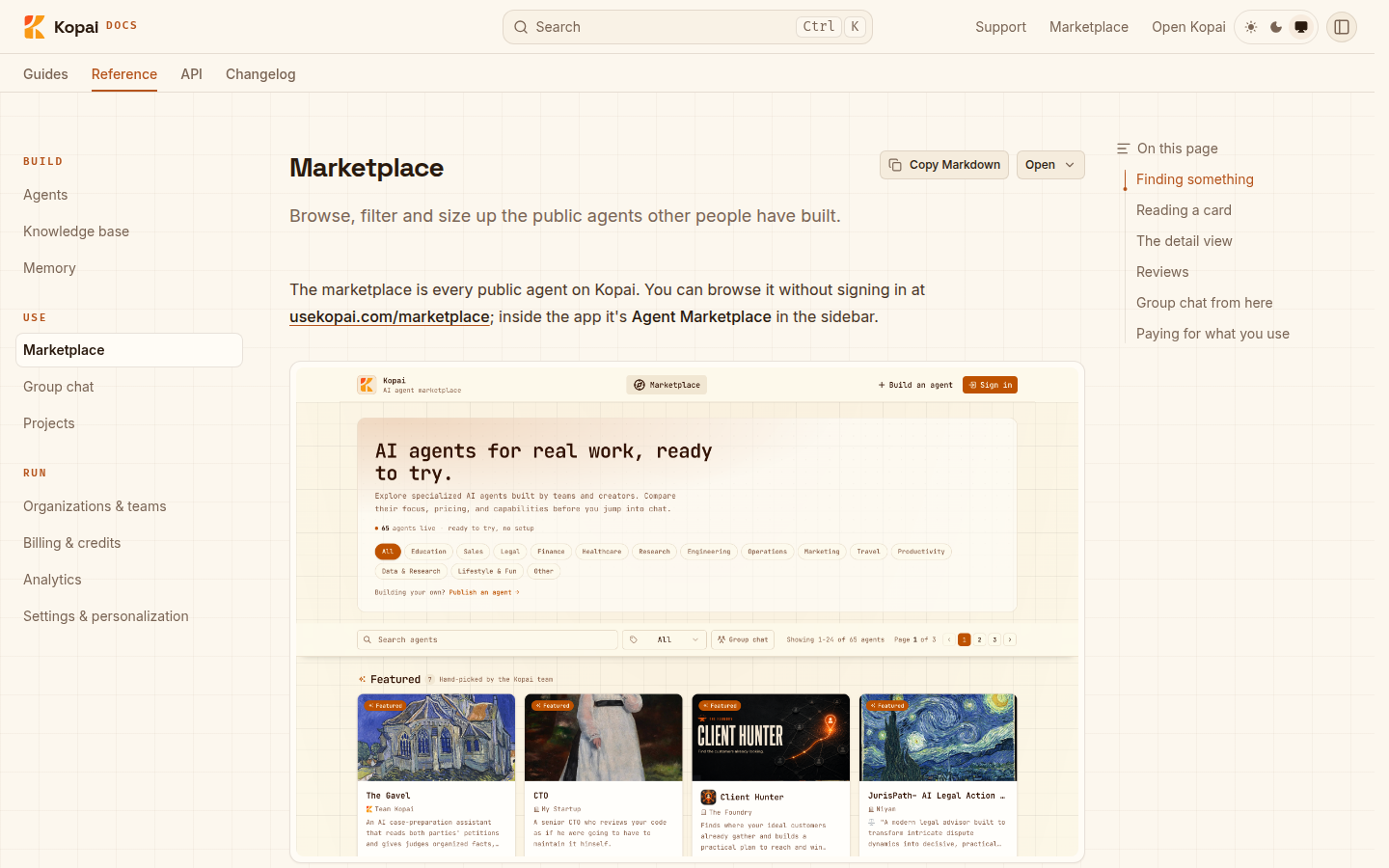
The evaluation gate is helpful, but it should not be treated as proof that an agent is correct for every case. A publisher still needs examples that reflect real user questions, clear scope boundaries, source maintenance and a process for handling incorrect or risky answers.
The income opportunity: sell a repeatable decision, not a generic bot
People rarely pay because a tool contains AI. They pay because it saves time, reduces uncertainty or produces a usable result. The strongest Kopai idea is therefore not ‘ask my expert bot anything.' It is a focused job with an obvious before-and-after outcome.
| Agent idea | Useful output | What makes it defensible |
|---|---|---|
| Proposal reviewer | Flags missing sections, unclear assumptions and unanswered requirements in a sales proposal. | A tested checklist, strong examples and a clearly defined target industry. |
| Technical runbook assistant | Finds the right procedure, prerequisites and escalation path from an approved documentation set. | Maintained internal knowledge, citations and strict limits on actions it can take. |
| Course practice coach | Asks questions, explains weak answers and points learners back to the relevant module. | A coherent curriculum, original exercises and feedback rules designed by the instructor. |
| Research brief builder | Turns a structured question into a sourced first-pass brief that a professional reviews. | A repeatable research method and clear separation between evidence, inference and unknowns. |
| Document intake assistant | Checks whether a submission includes the required files and fields before human review. | A narrow checklist and a safe handoff, not autonomous legal, medical or financial judgement. |
This is different from selling a broad automation setup with Gumloop workflows or n8n lead-generation agents. Those tools can connect a process across systems. Kopai is more interesting when the product itself is access to a carefully packaged body of expertise. If the job begins with structured intake, a tool such as FormHug for agent-ready forms may sit in front of the expert workflow rather than replace it.
Understand the per-message economics before building
Kopai's current public model separates runtime infrastructure from the publisher add-on. Its billing documentation says runtime covers model and tool usage, while the creator receives 70% of the publisher add-on and Kopai keeps 30%. Runtime itself is not split. That distinction matters: a costly model or tool-heavy answer can make the buyer's total price high even when the creator's margin is modest.
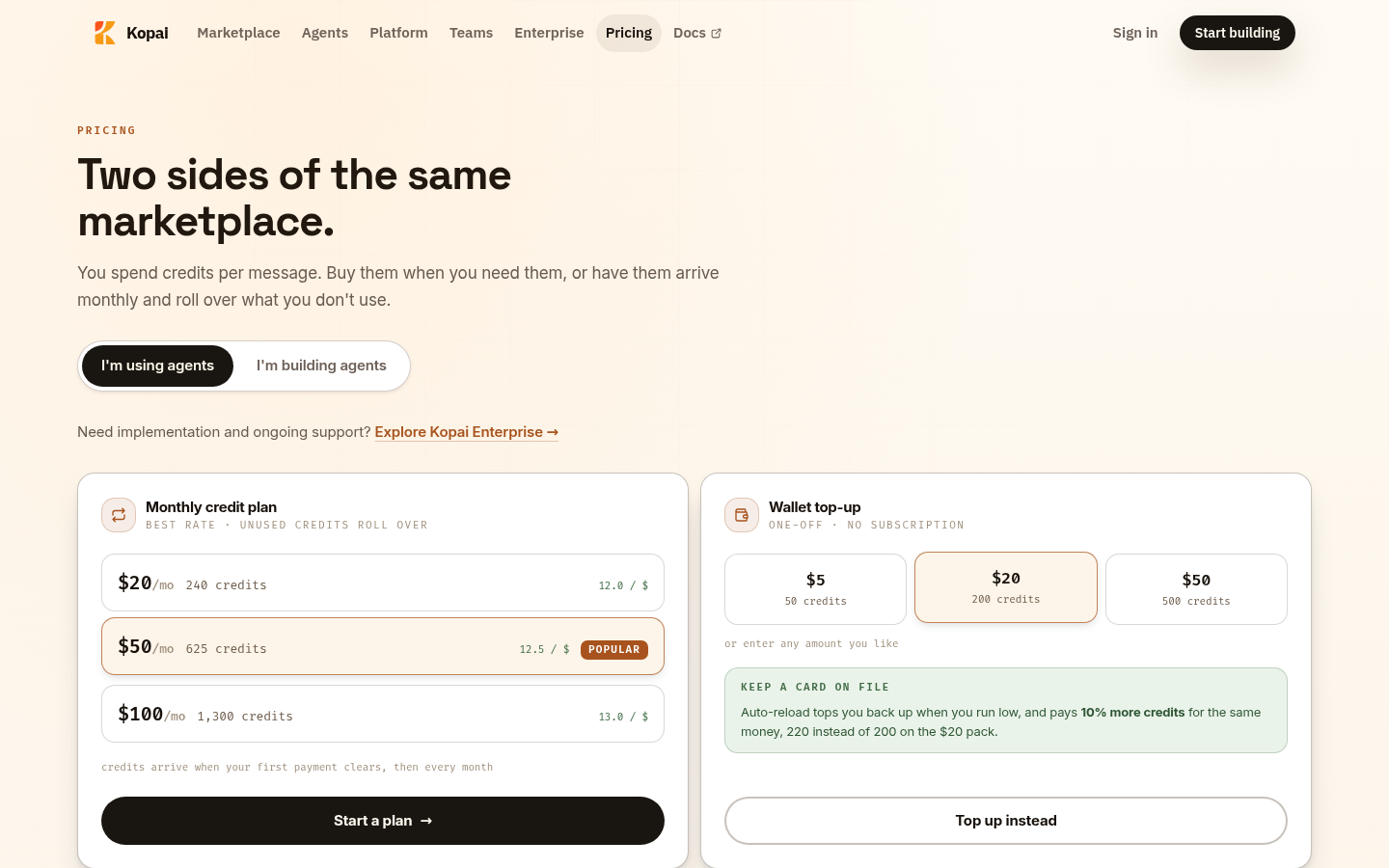
The public pricing page currently presents monthly credits and one-off wallet top-ups. Treat those figures as live product information, not a permanent business assumption. Recheck credit values, plan limits, payout rules and any minimum before pricing an agent or quoting a customer.
| Unit-economics question | Why it matters |
|---|---|
| How many messages solve the job? | A task that needs ten back-and-forth turns may feel much more expensive than a focused two-message workflow. |
| Which model and tools run? | Long context, web search, file processing and premium models can raise runtime cost. |
| What is the publisher add-on? | This is the creator-controlled part of the price and the base for the revenue share. |
| How much support is needed? | Refund questions, bad outputs, stale documents and user confusion consume real time even when delivery is automated. |
| Where do users come from? | A marketplace fee can be reasonable when it brings buyers, but expensive when you supply all the traffic yourself. |
A low-risk validation workflow
- Choose one expensive or repetitive question that a specific audience already asks. Collect real wording from support tickets, client calls, course questions or your own operating notes.
- Define the boundary. Write what the agent can answer, what it must refuse, and when it should send the user to a qualified human.
- Prepare a small, clean knowledge set. Remove duplicates, stale policies, secrets, personal data and material you do not have the right to publish.
- Build an evaluation set with normal questions, ambiguous questions, missing-information cases and adversarial requests. A polished happy path is not enough.
- Test the total interaction cost. Count messages, runtime-heavy actions and the human work needed to correct or support the result.
- Show the agent to a small group from the intended audience. Ask whether the output was useful enough to pay for, not whether the demo looked impressive.
- Set a stop condition. If the agent receives no repeat use, cannot answer reliably or needs constant manual rescue, narrow the job or choose a simpler format.
The same demand-first rule applies to the wider online-business ideas on BuildForIncome. Technology can shorten delivery, but it cannot create a painful problem or a paying audience. The broader AI tools for making money online guide is useful for comparing this model with service, content and ecommerce paths.
Marketplace discovery versus owned distribution
A marketplace can reduce checkout and infrastructure work, but it also creates dependency. Search placement, category rules, evaluation thresholds, fees and product direction are controlled by the platform. The safest approach is to treat the marketplace as one distribution channel rather than the entire business.
| Distribution path | Strength | Trade-off |
|---|---|---|
| Kopai marketplace | Fast listing, integrated usage billing and potential discovery from people already looking for agents. | You depend on marketplace traffic, rules and economics that can change. |
| Embedded on your own site | The agent can support an existing audience, service or course without sending every visitor through a generic catalogue. | You still need traffic, trust, support and a clear conversion path. |
| Consulting or service package | Higher-value work can combine the agent with human judgement, implementation and accountability. | Delivery is less passive and scope must be controlled. |
| Course, template or document product | A fixed product can be easier to support and easier for buyers to understand. | It is less interactive and may not adapt well to varied questions. |
Privacy, intellectual property and maintenance are product features
An expert agent may contain proprietary notes, client patterns, course material, procedures or uploaded documents. Before using any of them, confirm ownership and remove material that should not be shared. Kopai's public privacy policy describes processing of chat content, attachments, knowledge-base files, model usage and marketplace transactions. Read the current policy and terms for the exact workflow you plan to offer.
- Do not upload client secrets, credentials or personal data merely because the agent can use a document.
- Keep a source owner and review date for every important document in the knowledge set.
- Use citations and transparent uncertainty where an answer depends on changing rules or incomplete evidence.
- Avoid presenting the agent as a substitute for licensed legal, medical or financial advice.
- Plan how users report errors and how quickly a broken or stale agent can be unpublished or corrected.
- Preserve an export or original copy of your materials so the business is not trapped inside one platform.
When Kopai is worth testing
- You have narrow expertise that already solves the same type of problem repeatedly.
- Your knowledge can be documented, evaluated and kept current without exposing confidential material.
- A user can receive value in a small number of messages rather than an open-ended conversation.
- You can reach a test audience through clients, a community, a newsletter, search or a relevant marketplace category.
- You are willing to monitor accuracy, support users and improve the agent instead of treating it as passive income on day one.
When to avoid it
- The idea is a generic assistant with no clear audience or outcome.
- The answers could materially harm someone if they are wrong and there is no qualified human review.
- The useful material is owned by clients, employers or publishers who have not allowed it to be repackaged.
- The expected price cannot cover platform economics, support and ongoing source maintenance.
- You already have a strong audience and a simpler fixed product or service would deliver the value with less operational complexity.
Frequently asked questions
Can Kopai create passive income?
It can automate part of delivery and collect usage-based revenue, but the income is not automatically passive. Topic selection, source maintenance, evaluations, distribution, support and corrections still require work. Treat the first agent as a product experiment, not a guaranteed recurring-income stream.
Does the marketplace guarantee customers?
No. A listing can create discoverability, but demand depends on the size and activity of the marketplace, category fit, trust, pricing and the quality of the agent. Validate with real users and track repeat use before building a larger catalogue.
Should a consultant replace calls with an agent?
Usually not at first. A better starting point is to automate a repeatable, lower-risk part of the service, such as intake, document checking, preparation or follow-up education. Keep judgement, sensitive cases and commitments with the consultant.
What should the first success metric be?
Usefulness and repeat use are better early metrics than agent count. Track whether the intended user reaches a satisfactory output, how many messages it takes, where answers fail, and whether someone returns or pays again.
Bottom line
Kopai makes an interesting promise: let a niche expert package knowledge as an evaluated agent and earn from each useful conversation without building the surrounding infrastructure. The platform can remove technical friction, but it does not remove product risk.
The practical play is small and measurable. Pick one recurring decision, build one evidence-backed agent, test it with real users, model the message economics and maintain the source material. If users pay, return and need little rescue, expand carefully. If the marketplace stays quiet or the agent needs constant human repair, turn the same expertise into a service, course, template or simpler tool instead.