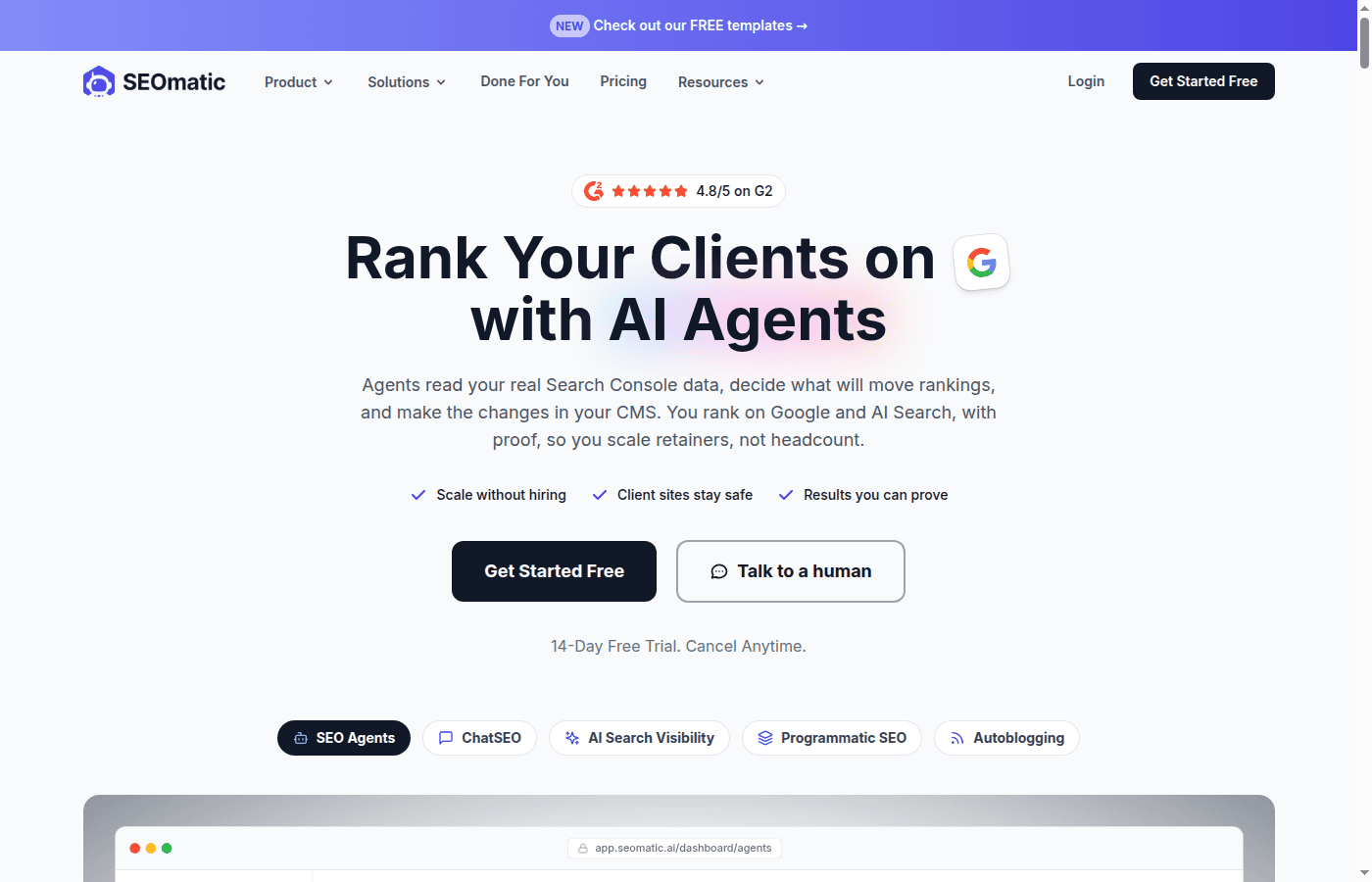
SEOmatic is worth watching because it does not only pitch AI writing. Its public positioning is closer to an autonomous SEO operations layer: agents read Search Console data, decide what should move rankings, and make changes in a CMS.
That is a big claim. For a small publisher, SaaS founder, or tiny agency, the useful question is not whether an AI SEO agent sounds impressive. It is whether programmatic SEO can create pages that deserve to rank, bring relevant visitors, and support a real business model without turning the site into thin scaled content.
| Quick verdict | What to know |
|---|---|
| Best fit | Agencies, SaaS teams, directories, marketplaces, and focused niche sites with repeatable page types or clear search clusters. |
| Money-making path | More qualified search entry points can support leads, trials, affiliate clicks, newsletter growth, sponsorship interest, or client retainers. |
| Main risk | Programmatic SEO can create hundreds of weak pages quickly if templates, data, uniqueness, search intent, and internal links are not controlled. |
| Worth testing when | You can start with one small cluster, review every output, and measure Search Console signals before scaling. |
| Avoid when | You need original hands-on reviews, expert judgement, legal/medical/financial precision, or guaranteed rankings. |
What SEOmatic appears to automate
The SEOmatic homepage describes AI agents that use real Search Console data, make CMS changes, and help rank on Google and AI Search. The pricing page was also public during this run and referenced plan tiers, CMS publishing, AI-search visibility, and a free trial.
In practical terms, this puts SEOmatic in the same broad AI SEO cluster as tools like SEObotAI and LLaMaRush, but with a stronger programmatic SEO and agency-operations angle.
| Claim area | What public sources indicate | Practical meaning |
|---|---|---|
| Search Console input | The public metadata says agents read clients' Search Console data. | Useful if the tool is refreshing or expanding from real query data rather than guessing topics blindly. |
| CMS changes | The homepage says agents can make changes in a CMS. | Powerful for agencies, but risky unless permissions, rollback and human approval are controlled. |
| Programmatic SEO | SEOmatic pages and independent roundups place it in the programmatic SEO tools category. | Best suited to repeatable page types, not one-off thought-leadership posts. |
| AI Search visibility | The official positioning mentions Google and AI Search visibility. | Interesting trend, but readers should treat AI-search claims as early and measure actual leads/clicks. |
How programmatic SEO can bring leads
Programmatic SEO works best when many pages follow a repeatable pattern and each page still has a reason to exist. The classic examples are comparison pages, integration pages, location pages, use-case pages, category pages, and data-backed directory pages.
| Use case | Money mechanism | Quality gate |
|---|---|---|
| SaaS comparison pages | Capture people searching for alternatives, integrations, or product-vs-product decisions. | Each page needs accurate positioning, real differences, and a clear next step. |
| Agency client sites | More qualified local or niche pages can support retainers and lead generation. | Avoid copy-paste city pages; add local proof, service detail and useful FAQs. |
| Affiliate or software sites | Programmatic supporting pages can funnel readers toward honest comparison or review pages. | Do not fake hands-on testing or invent commissions, screenshots, pricing or results. |
| Directories and marketplaces | Structured pages can match long-tail demand at scale. | Each listing/category needs useful data, filters, freshness and internal links. |
Where SEOmatic looks promising
- It addresses a real bottleneck for agencies and founders: SEO decisions, content updates, CMS publishing and proof reporting are hard to keep consistent.
- It sits in a live category with independent programmatic SEO tool roundups and tool-directory coverage, not just one isolated product page.
- The agency angle is commercially stronger than a generic AI writer because it can support client retainers, reporting and repeatable operating systems.
- For BuildForIncome, it naturally extends the existing AI SEO cluster without duplicating the exact SEObotAI or LLaMaRush angles.
Where to be skeptical
- Autonomous CMS changes are useful only if approvals, backups and rollback rules are clear.
- Programmatic SEO can become thin content if every page repeats the same template with tiny variable swaps.
- Search Console data helps, but it does not replace human judgement about intent, originality, trust, screenshots and business fit.
- Pricing and plan limits should be checked on the current pricing page before any paid test because terms, currency and billing periods can change.
- No SEO tool can guarantee rankings, AI citations, leads or revenue.

SEOmatic vs SEObotAI vs LLaMaRush
BuildForIncome already has separate posts on SEObotAI and LLaMaRush. SEOmatic should not be treated as just another AI-writing tool. The cleaner distinction is programmatic SEO and agency execution.
| Tool angle | Best fit | Main caution |
|---|---|---|
| SEOmatic | Agencies or teams that want SEO agents, CMS changes, Search Console-driven decisions and programmatic page systems. | Needs strong guardrails so scale does not become thin content. |
| SEObotAI | Founders who want an autonomous SEO robot for keyword research, content, internal links and blog momentum. | Still needs review before publishing and careful topic constraints. |
| LLaMaRush | Founders testing AI search optimization, SEO workflows and newer GEO/AEO positioning. | AI-search demand is real but still early; measure actual search and conversion outcomes. |
| Manual content ops | Original reviews, sensitive topics, expert content and pages where trust matters more than volume. | Slower, but often safer for high-stakes or high-conversion pages. |
A safer test plan
| Step | What to do | Why it matters |
|---|---|---|
| 1 | Pick one narrow cluster such as competitor alternatives, integration pages, or one service/location pattern. | A narrow cluster makes overlap and quality easier to judge. |
| 2 | Create a small batch of draft pages only. | Do not let automation publish hundreds of pages before you know the output is useful. |
| 3 | Compare each page against current search results and existing site inventory. | This catches duplicate intent and weak pages before publishing. |
| 4 | Add original examples, screenshots, data, client proof, product nuance or local detail. | This is what makes a scalable page useful rather than generic. |
| 5 | Track impressions, clicks, leads, assisted conversions and indexation before expanding. | The goal is useful search demand, not a bigger URL count. |
When SEOmatic is worth testing
- You already have a focused site, offer, client niche or repeatable database of page inputs.
- You can define publishing rules and review outputs before anything goes live.
- You have existing commercial or conversion pages that new supporting pages can link toward.
- You are comfortable measuring the test over weeks or months rather than expecting instant leads.
When to avoid it
- Avoid it if your site has no clear niche, offer or topical map.
- Avoid it if every page would be based on the same shallow template with little unique value.
- Avoid it if you cannot review CMS changes or recover from a bad update.
- Avoid it if you are trying to automate around a weak product, poor sales funnel or unclear audience.
For a broader context, this sits inside BuildForIncome's AI tools to make money online lane, but the best framing is more specific: use AI SEO agents to test one monetizable search system, then scale only when the data supports it.
Bottom line
SEOmatic is a strong BuildForIncome topic because it connects autonomous SEO agents, programmatic content, agency retainers, search traffic and lead generation. The upside is not automatic money; it is faster execution of a search strategy that already makes sense.
The safest takeaway is simple: test SEOmatic like an SEO operations system, not a magic ranking button. Keep the first batch small, review the pages, check the economics, and let Search Console plus real leads decide whether it deserves a larger role.