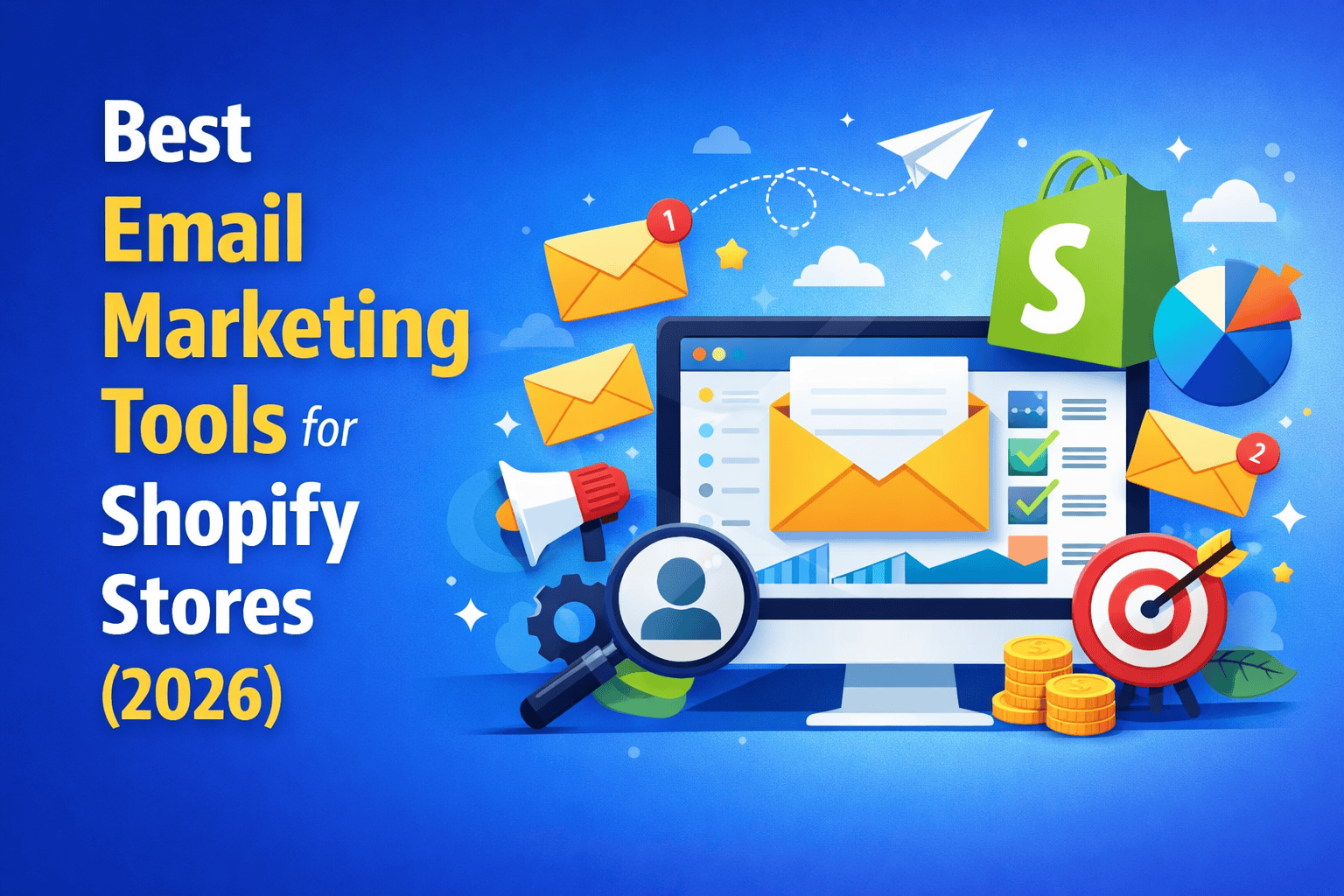
If you run a Shopify store, email marketing is not just about sending newsletters.
It is one of the main systems behind abandoned-cart recovery, repeat purchases, post-purchase follow-up, win-back campaigns, and customer segmentation. The right tool can help you turn store data into useful flows. The wrong tool can leave you with clunky automations, weak segmentation, and a lot of manual work.
That is why this guide is intentionally Shopify-first.
This is not a generic roundup of email marketing software for every kind of business. If you want a broader overview of general-purpose tools, read our full email marketing automation roundup (general).
This guide focuses specifically on what matters for Shopify stores:
- abandoned-cart workflows
- product and customer segmentation
- lifecycle automations
- practical Shopify integration fit
- whether a tool makes sense for a small store, a growing brand, or a more advanced ecommerce setup
We are keeping this practical and cautious on purpose. You will not find invented pricing, inflated feature claims, or fake “#1 best tool ever” nonsense here. Where details can change by plan, app version, or platform integration, they should be verified before publishing or implementing.
TL;DR quick picks
If you just want the short version:
Best for value-conscious stores that also care about transactional messaging: Brevo
Best for automation-heavy businesses that also want CRM depth: ActiveCampaign
Best for omnichannel ecommerce marketing: Omnisend
Best for advanced ecommerce segmentation: Klaviyo
Best for beginners who want a familiar starting point: Mailchimp
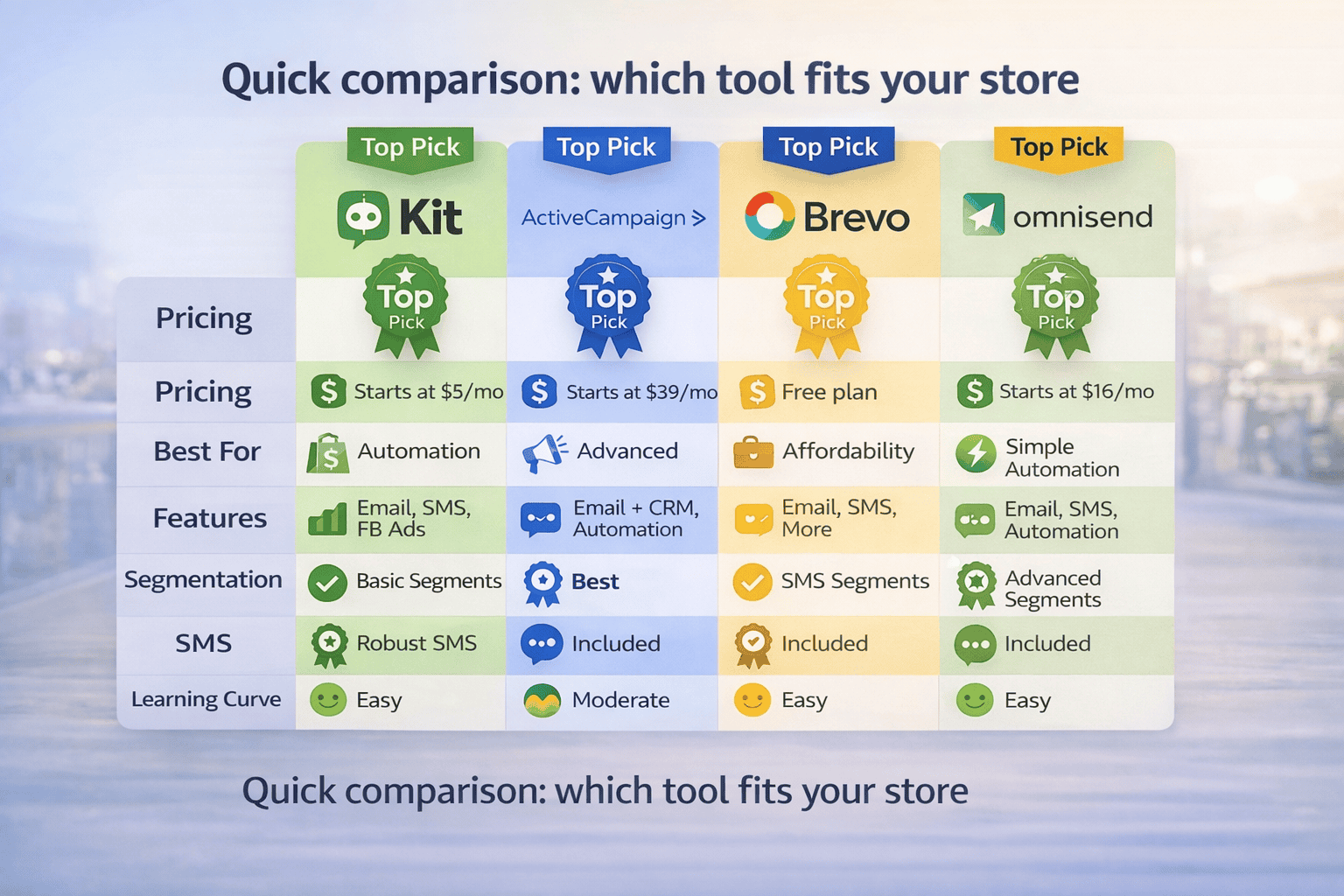
| Tool | Best for | Why it stands out | Better for | CTA |
|---|---|---|---|---|
| 🔥 Klaviyo | Advanced segmentation | Ecommerce lifecycle depth | Growth-focused brands | Read our full email marketing roundup |
| 📈 Omnisend | Email + SMS workflows | Practical omnichannel features | Teams wanting email+SMS | Try Omnisend |
| 💸 Brevo | Value-conscious stores | Transactional messaging & value | Smaller stores | Try Brevo |
| ⚙️ ActiveCampaign | Automation-heavy businesses | CRM-style automation depth | Complex customer journeys | Try ActiveCampaign |
| 🐣 Mailchimp | Beginners/simple campaigns | Familiarity & ease of entry | Early-stage stores | Read our full email marketing roundup |
That said, “best” depends heavily on what kind of Shopify store you run. A solo founder with a small catalog does not need the same setup as a brand doing serious segmentation and retention work. I’ll break that down properly below.
Why Shopify stores need a different email setup
A Shopify store has different needs than a local service business, a SaaS newsletter, or a creator email list.
For ecommerce, the real value usually comes from flows tied to customer and product behavior:
- cart abandonment
- browse abandonment
- welcome sequences
- post-purchase education
- cross-sell and upsell follow-up
- win-back flows for past customers
- segmentation by order history, product category, or buying behavior
That makes integration quality and ecommerce workflow fit far more important than generic “email marketing” branding.
A tool might be perfectly fine for newsletters and simple broadcasts but still be a weak fit for a Shopify merchant who needs:
- store-event sync
- customer segmentation
- product-driven campaigns
- repeatable automations tied to ecommerce behavior
That is the reason this article exists separately from our broader roundup. Shopify merchants usually need a more specific answer.
How we picked these tools
- Shopify-store use case fit
- Commercial and search-intent signals from our research
- Practical content fit for this site
We did not build this list by randomly naming the most popular email tools.
This shortlist was shaped by three things:
We prioritized tools that are commonly relevant to ecommerce workflows rather than generic newsletter software alone.
We reviewed workspace keyword research, intent reports, and SERP analysis around email automation and ecommerce-adjacent buying intent. That helped us focus on tools and article angles that match what store owners are actually searching for.
This article is intentionally narrower than our general roundup. The goal is to create a stronger Shopify-specific page that can stand on its own, link naturally to broader email content, and avoid becoming a duplicate of our general automation article.
In plain English: this list is built to answer a more specific question:
“If I run a Shopify store, which email marketing platform should I look at first?”
Not:
- “What are all email tools in existence?”
- “Which tool has the most hype?”
- or “Which brand name should be ranked #1 no matter what?”
Quick comparison block
Before you build the final table in WordPress, here is the clean text comparison version.
🔥 Klaviyo
- Best for: advanced segmentation and retention-focused Shopify stores
- Why it stands out: often associated with ecommerce-focused automation and data-driven customer flows
- Better fit for: growth-focused brands
- Caution: verify exact integration details and current feature fit before publishing
- More info: Read our full email marketing roundup
📈 Omnisend
- Best for: email + SMS ecommerce workflows
- Why it stands out: commonly considered by merchants who want omnichannel workflows without stitching together multiple separate tools
- Better fit for: merchants who want practical ecommerce messaging without too much complexity
- Caution: verify current Shopify integration and current plan fit before publishing
- More info: Read our full email marketing roundup
💸 Brevo
- Best for: budget-conscious stores and transactional messaging needs
- Why it stands out: practical option for stores that want value and broader messaging utility
- Better fit for: smaller stores and lean teams
- Caution: verify whether its ecommerce workflow depth fits your retention goals
⚙️ ActiveCampaign
- Best for: automation-heavy businesses with broader lifecycle needs
- Why it stands out: good fit when your email strategy overlaps with broader customer lifecycle management
- Better fit for: stores with more complex journeys
- Caution: may be more involved than a small store needs
🐣 Mailchimp
- Best for: beginners and simple campaign setups
- Why it stands out: widely recognized and easy to understand for many small business owners
- Better fit for: early-stage stores
- Caution: verify whether it still fits your Shopify workflow needs as your store becomes more segmentation-heavy
- More info: Read our full email marketing roundup
Best picks by store type
Not every Shopify business should buy the same tool.
If you are a small Shopify store just getting serious about email
Start by choosing something you can actually implement well.
A simpler, practical option is usually better than buying a sophisticated platform you will barely configure. For that reason, Brevo or Mailchimp may be more realistic starting points for smaller stores, especially if your current focus is:
- sending campaigns consistently
- building a welcome flow
- setting up basic abandoned-cart follow-up
- keeping costs and complexity under control
If that sounds like you, this related guide may help: affordable email tools for small stores.
If you are a growing Shopify brand focused on retention
This is where tools like Klaviyo or Omnisend usually become more compelling.
If your store is actively trying to improve:
- repeat purchase rate
- customer segmentation
- win-back flows
- product recommendations
- lifecycle personalization
then a more ecommerce-centered platform makes more sense.
If your business also needs CRM-style automation
If your store operations blend ecommerce with more complex customer journeys, sales processes, or multi-step follow-up, ActiveCampaign is worth considering.
It may not be the obvious pick for every pure-play store, but it can make sense where automation logic matters as much as campaign sending.
Tool deep dives
Klaviyo
Quick verdict
Klaviyo is the strongest fit on this list for stores that want their email setup to become a serious retention and segmentation engine.
Read our full email marketing roundup
Why it made the list
It made the shortlist because it is closely associated with ecommerce-focused lifecycle marketing. For a Shopify-first guide, that matters.
This is the kind of tool you consider when your questions sound like:
- How do we segment repeat buyers better?
- How do we create stronger win-back flows?
- How do we tailor campaigns to product or purchase behavior?
Best fit
- growth-focused Shopify stores
- brands that care about retention and segmentation
- merchants willing to put real thought into lifecycle strategy
Internal link
For a broader non-Shopify-specific comparison, see our full email marketing automation roundup (general).
Omnisend
Quick verdict
Omnisend is a practical pick for ecommerce teams that want a more direct email-and-SMS approach without overcomplicating the stack.
Why it made the list
It belongs here because a Shopify merchant often wants more than just broadcast emails. Omnichannel campaigns can matter, especially for promotions, cart recovery, and short lifecycle windows.
Best fit
- Shopify stores that want both email and SMS in one system
- teams that want ecommerce-specific workflows without an overly technical setup
- merchants looking for a middle ground between simplicity and ecommerce usefulness
Internal link
If you are still comparing lighter or cheaper options first, read affordable email tools for small stores.
Brevo
Quick verdict
Brevo is the value-minded option on this list. It is a sensible place to look if you want to avoid paying for more sophistication than your store currently uses.
Why it made the list
Brevo earns a place because some Shopify stores do not need a heavyweight ecommerce platform on day one. They need something practical, cost-conscious, and capable enough to cover campaigns plus important message types.
Best fit
- smaller stores
- budget-aware teams
- merchants balancing marketing and transactional messaging needs
Internal link
For more on Brevo specifically, read our Brevo (Sendinblue) review.
ActiveCampaign
Quick verdict
ActiveCampaign is the best fit here for stores that think in terms of customer journeys and automation logic, not just campaign sending.
Why it made the list
It stands out when your email stack is part of a broader lifecycle system. If your Shopify store also has longer buying cycles, lead capture, or more structured automation needs, that matters.
Best fit
- stores with more advanced automation goals
- brands blending ecommerce with broader customer journey management
- teams that care about workflow depth
Mailchimp
Quick verdict
Mailchimp still matters because many store owners start there or compare against it. It is familiar, accessible, and easy to understand.
Read our full email marketing roundup
Why it made the list
Even if it is not always the final answer for a growth-heavy Shopify brand, it remains a realistic benchmark option for smaller merchants.
Best fit
- beginners
- simple campaign setups
- smaller stores testing email seriously for the first time
Internal link
For simpler options and beginner-friendly choices, see affordable email tools for small stores.
Shopify-first notes, with WooCommerce and BigCommerce context
This article is intentionally written for Shopify stores first.
That means the decision criteria prioritize:
- Shopify integration fit
- store-event-based automation
- ecommerce segmentation
- retention flows
If you use WooCommerce or BigCommerce, the same shortlist may still be useful, but the integration details should be checked separately before publishing or implementation.
That is especially important for:
- how cart and checkout events are handled
- plugin/app setup
- product sync behavior
- any platform-specific workflow limitations
So the shortlist is broader than Shopify alone, but the framing and recommendations here are Shopify-first by design.
Actionable implementation checklist
- Connect the platform and verify data sync
- Set up one abandoned-cart flow first
- Create a welcome flow for new subscribers or new customers
- Segment by useful store behavior
- Add a post-purchase follow-up
- Review what you will actually send every month
- Avoid overbuilding too early
- Measure business outcomes, not just opens
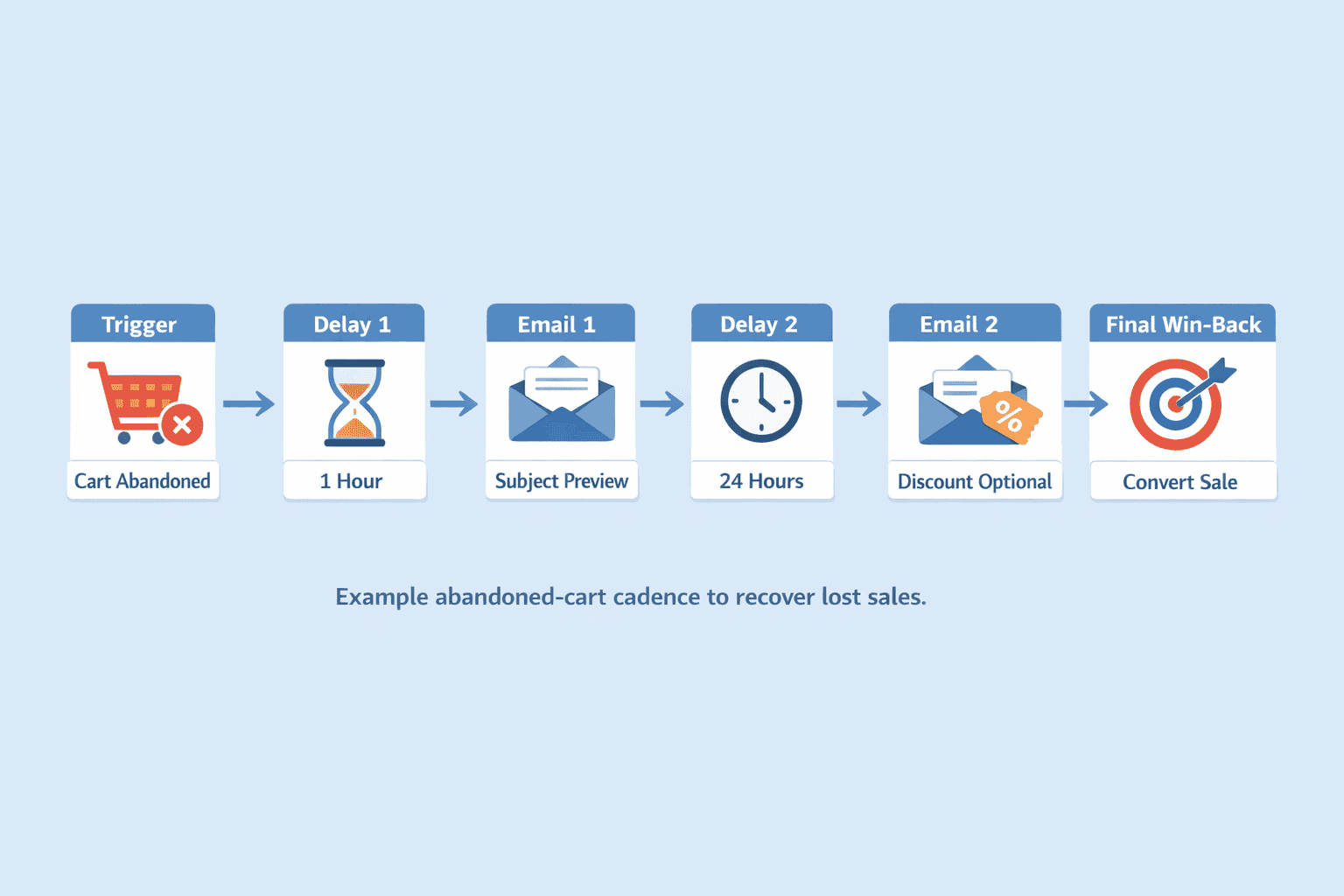
Once you choose a tool, do not stop at “integration connected.” That is not where the gains come from.
Use this rollout checklist instead:
- Check that customer, product, order, and cart-related data are arriving correctly.
- Do not assume the integration is working perfectly because the app says “connected.”
- Start with a simple sequence instead of trying to build everything at once.
- Keep the copy straightforward and test timing before adding complexity.
- This is one of the easiest ways to start building repeat engagement early.
- Start simple: first-time buyers, repeat buyers, recent customers, inactive customers.
- You do not need an advanced segmentation system on day one.
- Useful for education, cross-sell, reorder reminders, or review requests.
- Keep it relevant to what the customer actually bought.
- A tool is only as useful as the campaigns and flows you maintain.
- Choose the platform your team can realistically operate well.
- A small store does not need every possible automation.
- One working abandoned-cart flow plus a welcome flow beats ten half-finished automations.
- Focus on conversions, recovered carts, repeat purchases, and campaign revenue contribution where possible.
For strategic context on automation versus simpler campaign setups, read email vs automation for small businesses.
FAQ
What is the best email marketing tool for Shopify?
There is no single best tool for every store.
- If you want deeper segmentation and lifecycle marketing, Klaviyo is often one of the strongest options to evaluate.
- If you want omnichannel ecommerce messaging, Omnisend is worth serious consideration.
- If you want value and simplicity, Brevo may be the better fit.
- If you want beginner familiarity, Mailchimp is still a common comparison point.
What should a small Shopify store choose first?
A small store usually benefits more from a tool it can implement properly than from the most advanced option available.
That usually means prioritizing:
- ease of setup
- basic automation coverage
- sustainable cost
- practical campaign management
That is why Brevo and Mailchimp often make more sense for smaller stores than a more advanced setup they will not fully use.
Do Shopify stores really need advanced segmentation?
Not always.
If your store is early-stage, basic flows and a few useful customer segments may be enough. More advanced segmentation becomes more valuable as:
- your product catalog grows
- repeat purchase matters more
- customer behavior varies more
- retention becomes a bigger part of growth
Which tool is best for abandoned-cart emails on Shopify?
The better question is not just “which tool has abandoned-cart email,” but “which tool fits the rest of my store’s lifecycle needs?”
Most serious candidates in this article can play a role there. The difference is how well they support:
- segmentation
- overall ecommerce workflow fit
- future retention strategy
- your team’s actual level of sophistication
Should I choose a Shopify-first tool or a general email platform?
If ecommerce is central to your business, a Shopify-first or ecommerce-oriented tool is usually the better starting point.
If Shopify is only one part of a broader business with CRM-heavy needs, a more general automation platform may still make sense.
How is this article different from your general email roundup?
This guide is specifically for Shopify merchants and ecommerce workflows.
Our broader roundup is here: full email marketing automation roundup (general).
That article is wider. This one is narrower and more practical for store owners who care about abandoned carts, segmentation, and ecommerce growth.
Conclusion: the right recommendation depends on your store stage
If you want the shortest possible recommendation path, use this:
- Choose Klaviyo if your store is serious about segmentation, retention, and customer lifecycle depth.
- Choose Omnisend if you want a more direct ecommerce marketing setup that includes omnichannel potential.
- Choose Brevo if you want a more practical, value-conscious option without jumping straight into a more advanced stack.
- Choose ActiveCampaign if automation logic and broader lifecycle management matter as much as ecommerce campaigns.
- Choose Mailchimp if you are still early, want a familiar entry point, and need a simpler place to start.
The mistake is not choosing the “wrong #1 tool.”
The mistake is choosing a system that does not match your current store stage, team capacity, or retention strategy.
If you want the broader non-Shopify version of this decision, start here: full email marketing automation roundup (general).
And if you are still trying to keep things lean, this is the better next read: affordable email tools for small stores.